

2026 Best Colorant Masterbatch for Global Buyers
For global buyers, selecting the 2026 best Colorant Masterbatch requires more than comparing shade cards and price lists. A reliable choice must connect color accuracy with polymer compatibility, processing stability, weather resistance, and documented quality control. Dr. Renzo Shamey, a respected researcher in industrial color science, emphasizes that color should be treated as a measurable industrial variable, not merely a visual preference. That principle remains highly practical for today’s masterbatch purchasing teams.
A strong Colorant Masterbatch should disperse evenly through the chosen resin. It should also maintain stable color during extrusion, injection molding, or film production. Buyers need to examine pigment concentration, carrier resin, melt flow behavior, thermal resistance, and migration performance. Small differences can become visible on a white automotive panel or a transparent food container. They can also create costly production waste.
Samples matter.
Laboratory data matters more.
Yet data alone is not enough. A supplier may provide excellent technical sheets but respond slowly when a production issue appears. Global buyers should review batch-to-batch consistency, retained samples, factory controls, packaging protection, and technical support. Independent testing can strengthen confidence, especially for demanding outdoor or high-temperature applications. Regional requirements also deserve careful review.
No masterbatch is perfect for every polymer or process. That assumption can mislead even experienced teams. A trial may expose unexpected streaks, gloss changes, or filter pressure. Those results are not failures to hide. They are useful evidence for refining dosage, processing temperature, and resin selection. This 2026 guide examines these practical factors, helping buyers choose Colorant Masterbatch with clearer judgment and fewer costly surprises.
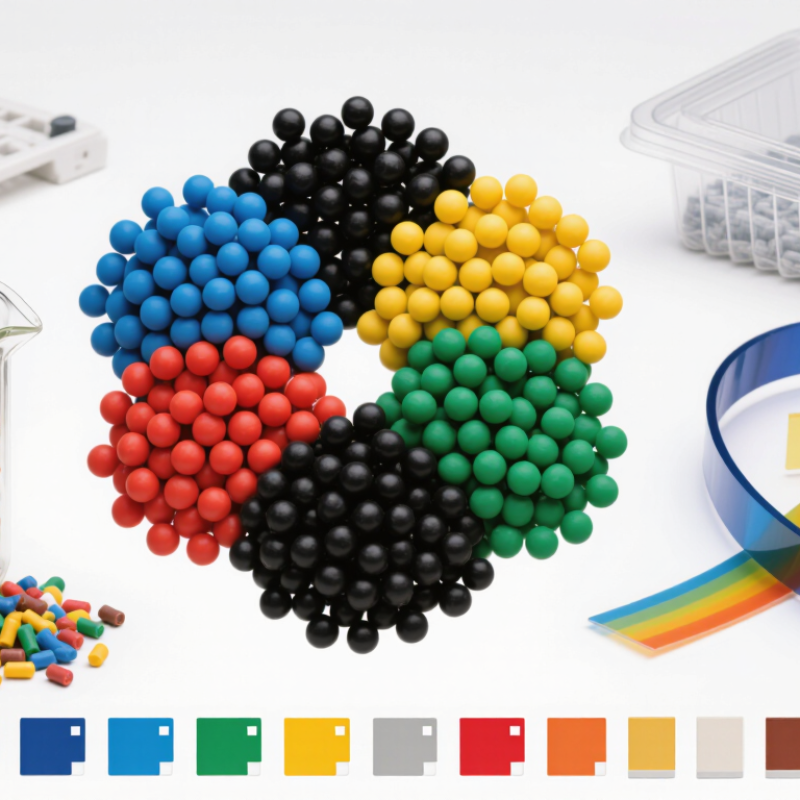
Colorant Masterbatch Fundamentals: 20–70% Pigment Loading and 1–5% Let-Down
For global buyers, colorant masterbatch begins with pigment loading, not a catalogue shade. A concentrate containing 20–70% pigment can reduce handling volume and improve dosing efficiency. Yet higher loading may increase viscosity, dispersion risk, or filtration pressure. The carrier resin must match the target polymer and processing temperature.
A practical let-down ratio usually ranges from 1–5%. At 1%, a 50% pigment concentrate delivers about 0.5% pigment in the final resin. At 5%, the same masterbatch delivers approximately 2.5%. Small dosing changes can alter opacity, shade strength, and mechanical performance. Trial runs matter.
The scale is significant. PlasticsEurope reported global plastics production of 413.8 million tonnes in 2023. Grand View Research’s 2024 masterbatch analysis estimated the wider market at about USD 12.4 billion in 2023, with continued growth expected through 2030. These figures suggest strong demand, but they do not guarantee universal formulation success. A colorant that performs well in injection molding may behave differently in film extrusion. I have seen specifications look complete while omitting screw design, moisture limits, and residence time. That is a costly gap. Buyers should request dispersion data, pigment concentration, carrier details, recommended let-down, and test conditions before approval. A higher pigment percentage is not automatically better.
| Colorant Masterbatch Category | Typical Pigment Loading | Typical Let-Down Ratio | Illustrative Final Pigment Level in Polymer | Common Polymer Compatibility | Typical Applications | Key Buyer Evaluation Points |
|---|---|---|---|---|---|---|
| Organic Color Pigments | 20–40% | 1–3% | 30% × 3% = 0.90% | PE, PP, PS, ABS and selected engineering polymers | Bright red, yellow, orange, green, blue and violet shades for packaging, consumer goods and molded parts | Tint strength, heat stability, migration resistance, lightfastness and shade consistency |
| Inorganic Color Pigments | 40–70% | 1–5% | 50% × 2% = 1.00% | PE, PP, PVC, HDPE and other thermoplastics, subject to carrier compatibility | Durable earth tones, oxide reds, oxide yellows, greens and other high-stability colors | Weatherability, heat resistance, chemical resistance, density and dispersion quality |
| Titanium Dioxide White Masterbatch | 50–70% | 1–5% | 60% × 1.5% = 0.90% | PE, PP, film, sheet, injection molding and blow molding grades | White films, household products, containers, caps, sheets and opaque molded articles | Whiteness, opacity, undertone, dispersion, moisture level and carrier resin suitability |
| Carbon Black Masterbatch | 20–50% | 1–3% | 40% × 2% = 0.80% | PE, PP, PVC, ABS and selected recycled polymer compounds | Black films, pipes, agricultural products, cable compounds, automotive parts and packaging | Jetness, undertone, UV protection, surface appearance, dispersion and electrical behavior |
| Transparent or Translucent Color Masterbatch | 20–35% | 1–3% | 25% × 2% = 0.50% | PP, PE, PET and selected styrenic polymers | Transparent packaging, caps, containers, films and decorative components | Transparency, haze, color strength, thermal stability and compatibility with the base resin |
| High-Opacity Color Masterbatch | 40–70% | 1–5% | 50% × 3% = 1.50% | PE, PP, PVC and other compatible thermoplastics | Opaque films, injection-molded products, pipes, sheets and multilayer packaging components | Hiding power, pigment dispersion, melt flow impact, surface defects and processing window |
| General-Purpose Color Masterbatch | 20–50% | 1–5% | 30% × 2% = 0.60% | Usually designed for a defined carrier system such as PE, PP or PS | Everyday packaging, stationery, household goods and non-critical molded products | Carrier matching, batch-to-batch color control, processability, storage stability and regulatory documentation |
| High-Temperature Engineering-Polymer Masterbatch | 20–50% | 1–3% | 30% × 2% = 0.60% | Selected grades of ABS, PC, PA, PBT and other engineering polymers | Automotive interiors, electrical components, appliances and technical molded parts | Long-term heat stability, residence-time stability, warpage risk, mechanical-property retention and polymer compatibility |
| Film-Grade Color Masterbatch | 20–50% | 1–5% | 40% × 2.5% = 1.00% | LDPE, LLDPE, HDPE and PP film grades | Packaging films, agricultural films, carrier bags, liners and lamination layers | Filter pressure, gel formation, dispersion, blocking, coefficient of friction and film appearance |
| Injection-Molding Color Masterbatch | 20–60% | 1–3% | 40% × 2% = 0.80% | PP, PE, ABS, PS and other compatible molding polymers | Caps, closures, containers, appliances, toys and consumer products | Color repeatability, weld-line appearance, flow behavior, cycle stability and surface finish |
Organic, Inorganic, and Carbon-Black Pigments: C.I. Index and Opacity Data
For global buyers, a pigment’s C.I. Index is more useful than a trade name. Pigment White 6 identifies titanium dioxide, while Pigment Blue 15:3 indicates copper phthalocyanine. Pigment Yellow 12 and Pigment Black 7 are common organic and carbon-black references. Color Index International remains the recognized classification source.
Opacity depends on more than pigment loading. Titanium dioxide usually provides the strongest hiding power because its refractive index is about 2.7. Carbon black offers intense visual depth, but dispersion quality controls streaking and surface defects. Organic pigments often deliver brighter shades, yet they may require higher concentrations for equal coverage. ASTM D2805 measures opacity through contrast ratio, while ISO 787-15 evaluates tinting strength. Buyers should request both results.
The 2024 Ceresana market study identifies packaging and consumer goods as major masterbatch demand areas. Its regional analysis also shows continuing growth in Asia-Pacific processing capacity. These figures support practical sourcing, but they do not replace laboratory trials. A masterbatch with 50% pigment may still perform poorly in a thin film. I would compare C.I. identity, particle dispersion, carrier compatibility, and contrast-ratio data under the target process. One gap remains: suppliers do not always report test conditions clearly. That weakness deserves attention.
Performance Testing: ΔE Color Accuracy, 1–8 Lightfastness, and Heat Stability
For global buyers, the best colorant masterbatch in 2026 must prove performance, not merely display a bright sample. Measure color difference with a calibrated spectrophotometer under controlled lighting. ASTM D2244 supports calculating ΔE from instrumental color coordinates. A low ΔE value indicates closer color agreement, but acceptance limits depend on the product and customer. Many processors target ΔE00 below 1.0 for demanding visual parts. That target is useful, not universal.
Lightfastness needs a clear scale. ISO 105-B02 uses Blue Wool ratings from 1 to 8. Grade 1 fades quickly, while Grade 8 offers the highest resistance. Xenon-arc exposure can reveal fading, hue shifts, and surface chalking. Record exposure duration, irradiance, temperature, and humidity. A masterbatch passing one laboratory cycle may still behave differently outdoors. That uncomfortable gap deserves attention.
Heat stability should be tested near the real processing window. Compare color before and after residence at the planned melt temperature. ASTM D3418 can help identify thermal transitions, while TGA data supports degradation screening. Watch for yellowing, black specks, viscosity changes, and plate-out. I would not trust one plaque alone; use multiple batches and recycled-content samples.
Tips: Request the resin carrier, pigment loading, recommended dosage, and test method. Match the buyer’s ΔE calculation, light source, and exposure standard. Keep a retained reference plaque for every approval. Mistakes happen. Good records make them visible.
Global Compliance: REACH, FDA, EU 10/2011, and Recycled-Content Standards
2026 Best Colorant Masterbatch for Global Buyers
Global Compliance: REACH, FDA, EU 10/2011, and Recycled-Content Standards
For global buyers, the best colorant masterbatch is compliant before it is vivid. REACH requires a substance-based review, not a simple supplier declaration. Confirm registration status, SVHC communication, restricted substances, and exposure conditions for every additive. For food packaging, EU Regulation 10/2011 requires composition checks and migration testing under intended conditions. The U.S. route differs. Colorants and carriers may need clearance under applicable food-contact rules, including 21 CFR provisions or another valid authorization pathway. Do not treat an FDA letter as universal approval. It may cover one formulation, polymer, or use condition only. Small detail, large risk.
Recycled-content claims need equal discipline. Plastics Europe reported 413.8 million tonnes of global plastics production in 2023. OECD’s Global Plastics Outlook estimates that only 9% of plastic waste was recycled globally in 2019. That gap makes traceability essential. Request mass-balance records, source declarations, contaminant controls, and chain-of-custody evidence. In factory audits, I compare technical data sheets with batch records, pigment declarations, and migration reports. A neat certificate pack can still hide an outdated test. Color strength may pass while odor, heavy metals, or NIAS remain unresolved. Independent laboratory verification is wise. It is not perfect, either. Recycled feedstock varies by lot, and testing methods differ. Buyers should define acceptance limits, retain samples, and repeat testing after formulation changes. Compliance is a moving target, not a one-time stamp.
2026 Best Colorant Masterbatch for Global Buyers — Global Compliance Milestones
Key regulatory milestones and recycled-content targets relevant to colorant masterbatch selection. These dates describe regulatory frameworks or legal targets, not product certification.
REACH entered into force in 2007. EU Regulation 10/2011 established specific rules for plastic materials intended to contact food. The FDA food-contact framework is based on U.S. food-additive and food-contact regulations, including the 1958 Food Additives Amendment. Under EU recycled-content requirements, PET beverage bottles must contain at least 25% recycled plastic from 2025, while plastic beverage bottles must contain at least 30% recycled plastic from 2030.
Supplier Selection Scorecard: Cost, MOQ, COA, ISO 9001, and Supply Capacity
For 2026 colorant masterbatch sourcing, a scorecard should convert supplier claims into measurable evidence. PlasticsEurope’s Plastics—the Fast Facts 2024 reports 400.3 million tonnes of global plastics production in 2022. That scale makes supply continuity more important than a low first quotation.
COA quality should carry 20%. Require melt flow rate, pigment concentration, moisture, density, and color difference data for every lot. A COA without test methods is weak evidence. Ask for retained samples and a clear correction process. ISO Survey 2022 recorded more than 1.2 million ISO 9001 certificates worldwide, but certification alone cannot prove color consistency. Check the certificate scope, audit date, and production site. Small details matter.
MarketsandMarkets’ masterbatch research identifies packaging, consumer goods, and automotive applications as major demand areas, yet forecasts differ between reports. That is worth remembering. Do not treat one projection as certainty. A supplier may offer excellent color matching but fail during a sudden order increase. Test capacity before approval, not after a production delay.