2026 Best Waterproof Outdoor LED Screen Buying Guide?
Choosing a waterproof outdoor LED screen is not simply a matter of selecting the highest IP rating. Rain, dust, heat, wind, and direct sunlight can expose weak components within months. Outdoor-display engineer Mark O’Brien describes the principle clearly: “Waterproofing is not a feature; it is a system of decisions.”
Those decisions begin with the enclosure, module seals, drainage channels, cable entries, and cabinet ventilation. A reliable screen should manage water without trapping heat. That balance is easy to overlook. Brightness also matters. A display under strong afternoon sunlight needs sufficient brightness, while automatic adjustment can reduce glare and energy use after sunset.
This 2026 buying guide examines the details that affect real-world performance. It compares IP ratings, pixel pitch, front and rear maintenance, refresh rate, cabinet materials, power consumption, and control-system compatibility. It also considers wind exposure, installation height, viewing distance, and access for routine service.
Do not trust specifications alone.
Ask how the manufacturer tested the screen. Request evidence of environmental testing, warranty coverage, spare-part availability, and long-term technical support. A waterproof outdoor LED screen may perform well in a showroom but struggle beside a coastal road or a dusty sports field.
There is no perfect purchase. Even premium equipment can fail when installation is rushed or drainage is blocked. That uncomfortable point deserves attention. The best choice combines verified engineering, practical maintenance planning, and a supplier willing to support the screen after installation.
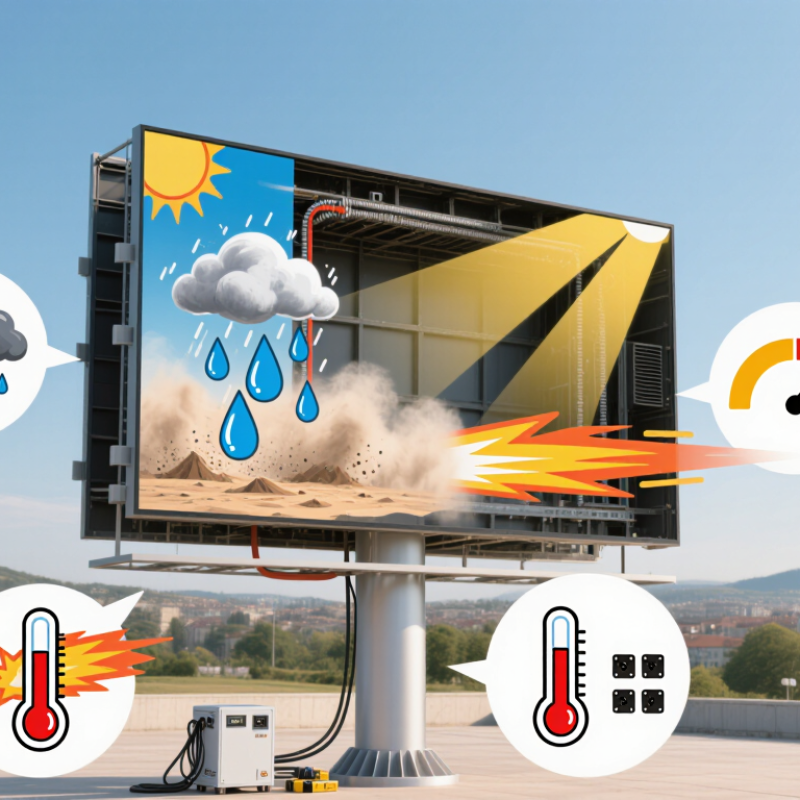
What Defines a Waterproof Outdoor LED Screen in 2026
In 2026, waterproof means verified protection, not a sales adjective. IEC 60529 classifies IP65 as dust-tight and protected against water jets. It does not approve immersion. IP66 handles stronger water jets, while IP67 covers temporary immersion. That distinction matters beside pools, sprinklers, or roof edges.
An outdoor LED cabinet should protect modules, power supplies, connectors, and cable entries, not only its front mask. Look for separate front and rear IP test results, sealed cable glands, drainage paths, and corrosion-resistant fasteners. During commissioning, technicians should inspect gaskets after opening, spray-test vulnerable joints, and check brightness after a wet, cold night. Rain is not the only enemy. Condensation can form inside a warm cabinet when temperatures fall quickly. Poor ventilation makes this worse. IP ratings also say little about sunlight, salt mist, wind pressure, or maintenance quality. These gaps deserve more attention.
Mordor Intelligence’s 2025 LED Display Market analysis estimates the market near USD 9.3 billion in 2025, with continued growth through 2030. Grand View Research also places the 2024 market above USD 9 billion. Growth is expanding outdoor installations, but market size cannot prove waterproof reliability. Specify IEC 60529 test evidence, operating temperature limits, drainage design, and warranty conditions. I would not treat an IP claim as invincible. A cheap rating can survive a brochure review. It may not survive a monsoon.
How to Choose Screen Size, Pixel Pitch, and Viewing Distance
2026 Best Waterproof Outdoor LED Screen Buying Guide: How to Choose Screen Size, Pixel Pitch, and Viewing Distance
Outdoor LED selection starts with distance, not screen size. Measure the shortest and longest viewer positions on site. For a roadside display, calculate from the nearest safe stopping point. For a stadium, measure from the highest seating row. A common field formula estimates minimum viewing distance as pixel pitch in millimeters multiplied by one meter. A 6 mm pitch may look acceptable from about six meters, while a 3 mm pitch needs roughly three meters. This is a planning guide, not a guarantee.
Screen size should match viewing angle and message length. A narrow sign may need extra height for readable text. A wide plaza display can use a larger width without increasing pixel density. The 2024 AVIXA Industry Outlook and Trends Analysis emphasizes application-based system planning, including audience position, content, and operating conditions. Outdoor brightness also matters. Professional integrators commonly specify 5,000 to 7,000 nits for direct sunlight, then adjust after a daylight survey. More brightness is not automatically better; it can increase power use and glare.
Pixel pitch affects both detail and budget. Smaller pitch improves close viewing, but it adds LEDs, processing demand, and maintenance cost. IEC 60529 guidance supports checking IP ratings, with outdoor enclosures often targeted at IP65 or higher. Still, an IP rating does not prove long-term waterproof performance. Ask for thermal testing, drainage details, and repair access. I would not trust a calculator alone. Shadows, viewing height, camera use, and changing sunlight can make a technically correct choice feel wrong. Test a full-size sample outdoors before ordering.
2026 Best Waterproof Outdoor LED Screen Buying Guide? - How to Choose Screen Size, Pixel Pitch, and Viewing Distance
Use the following planning ranges to match outdoor LED screen specifications with viewing distance, image detail, weather exposure, and installation conditions. Actual requirements may vary according to content type, ambient light, local regulations, and structural design.
| Application Scenario | Typical Screen Size | Recommended Pixel Pitch | Approximate Minimum Viewing Distance | Recommended Maximum Viewing Distance | Recommended Brightness | Recommended Refresh Rate | Weatherproofing and Key Requirements |
| Outdoor retail signage | 2–6 m² | P4–P6 | 4–6 m | 40–60 m | 5,000–6,500 nits | ≥ 3,840 Hz | Front or rear service, automatic brightness control, high-contrast content, and an outdoor-rated cabinet. |
| Building facade advertising | 20–200 m² | P6–P10 | 6–10 m | 60–150 m | 5,000–7,000 nits | ≥ 3,840 Hz | Lightweight cabinets, wind-load calculation, drainage, corrosion protection, and a dedicated maintenance access plan. |
| Roadside billboard | 30–120 m² | P8–P10 | 8–10 m | 100–250 m | 6,000–8,000 nits | ≥ 3,840 Hz | High daytime brightness, strong contrast, automatic dimming, anti-glare treatment, and compliance with road-safety rules. |
| Sports venue perimeter display | 10–80 m² | P6–P10 | 6–10 m | 80–180 m | 5,000–7,000 nits | ≥ 3,840 Hz | Protective soft mask or impact-resistant cover, stable motion reproduction, redundant power, and safe viewing angles. |
| Outdoor event or concert screen | 12–60 m² | P4–P6 | 4–6 m | 80–150 m | 4,500–6,500 nits | ≥ 3,840 Hz; 7,680 Hz for camera-heavy production | Fast setup, modular cabinets, high refresh rate, camera-friendly scan configuration, and secure temporary anchoring. |
| Public information display | 4–25 m² | P4–P6 | 4–6 m | 50–100 m | 4,000–6,000 nits | ≥ 3,840 Hz | Readable text at moderate distance, automatic brightness adjustment, remote monitoring, and reliable 24/7 operation. |
| Outdoor transport hub | 6–40 m² | P3.9–P6 | 4–6 m | 60–120 m | 5,000–7,000 nits | ≥ 3,840 Hz | Clear text rendering, high uptime, front maintenance where space is limited, surge protection, and network redundancy. |
| Long-distance highway display | 50–150 m² | P10–P16 | 10–16 m | 150–400 m | 6,000–8,000 nits | ≥ 3,840 Hz | Large characters, wide viewing angle, high wind resistance, automatic dimming, and strict control of glare and content timing. |
| Pixel Pitch | LED Pixel Density | Best-Fit Viewing Distance | Typical Content Quality | Planning Recommendation |
| P3.9–P4 | Approximately 62,500–65,000 pixels/m² | 4–80 m | Detailed text, product images, close-range video, and live camera content | Choose when viewers may stand close to the display and image detail is important. |
| P5–P6 | Approximately 27,800–40,000 pixels/m² | 5–120 m | General advertising, public information, sports, and event video | A practical balance between image detail, viewing distance, and project cost. |
| P8–P10 | Approximately 10,000–15,625 pixels/m² | 8–250 m | Large graphics, logos, headlines, and high-impact advertising | Suitable for large screens viewed from roads, plazas, and open outdoor areas. |
| P12–P16 | Approximately 3,900–6,944 pixels/m² | 12–400 m | Large-format text, simple graphics, and distant viewing | Use when the screen is very large and the primary audience is far away. |
| Selection Factor | Recommended Specification or Calculation | Why It Matters |
| Screen size | Define physical width and height from the viewing zone, content layout, mounting area, and cabinet dimensions. | A larger screen is not always better; the display should fit the structure and remain readable from the intended audience area. |
| Pixel pitch | Use the smallest pitch that is justified by the closest regular viewing distance and required image detail. | Smaller pitch improves close-range detail but generally increases pixel count, processing requirements, and project cost. |
| Minimum viewing distance | As a practical estimate, minimum distance in meters is approximately equal to pixel pitch in millimeters. | For example, a P6 display is generally viewed comfortably from about 6 m or farther, depending on content and visual requirements. |
| Brightness | Approximately 4,000–8,000 nits for most outdoor applications, with automatic dimming for night operation. | Brightness must overcome sunlight without creating excessive glare or disturbing nearby traffic and residents. |
| Ingress protection | Use at least IP65 for the front of fixed outdoor LED modules; sealed rear protection may be required in exposed installations. | The IP rating indicates protection against dust and water ingress. It does not replace drainage, sealing, or correct installation. |
| Refresh rate | At least 3,840 Hz for general video and camera use; consider 7,680 Hz for demanding broadcast or professional production. | A higher refresh rate helps reduce visible scan lines and flicker in camera recordings, subject to the complete system configuration. |
| Viewing angle | Common outdoor LED displays provide approximately 120° horizontal and 120° vertical viewing angles. | A wide angle helps maintain consistent visibility when viewers approach from different directions. |
| Operating temperature | Specify a qualified operating range, commonly around −20°C to +50°C, with ventilation or cooling designed for the site climate. | Temperature control affects LED lifetime, brightness stability, power consumption, and long-term reliability. |
| Power planning | Allow separate calculations for average consumption, maximum consumption, circuit capacity, surge protection, and backup power. | Actual power use changes with brightness, content, refresh settings, ambient temperature, and display configuration. |
| Installation structure | Verify cabinet weight, wind load, foundation, drainage, grounding, cable routing, and local permit requirements before purchase. | The support structure and electrical installation are essential safety components of an outdoor LED project. |
Which Waterproof Ratings and Weatherproof Features Matter Most
2026 Best Waterproof Outdoor LED Screen Buying Guide
An outdoor LED screen needs more than a bright display and a high IP number. Start with the enclosure’s IP rating, which measures protection against dust and water. IP65 blocks dust and low-pressure water jets, making it suitable for many fixed installations. IP66 offers stronger water protection during storms. IP67 protects against temporary immersion, but it does not automatically improve screen performance. Rain is not enough. Salt, dust, heat, and freezing temperatures also matter.
Look for sealed cabinets, sloped drainage channels, gasketed doors, and secure cable glands. These details prevent water from collecting behind modules. Conformal coating can protect circuit boards from humidity, while corrosion-resistant metal helps in coastal areas. Check the approved operating temperature, wind-load rating, and ventilation design. A sealed cabinet still needs effective heat control under direct summer sunlight. Details matter.
During installation checks, inspect every cabinet seam and cable entry, not just the front surface. A small gap can cause repeated failures after heavy rain. I once underestimated drainage because the screen passed a short spray test. That result was useful, but incomplete. Ask for test conditions, certification documents, and maintenance instructions. Confirm whether the warranty covers moisture, condensation, and storm exposure. An IP rating alone can mislead. The strongest choice matches the local climate, mounting position, and service access.
What Installation, Maintenance, and Budget Factors Should You Check
When selecting a waterproof outdoor LED screen for 2026, inspect installation conditions before comparing pixel pitch. A reliable cabinet should provide at least IP65 protection on the display surface, while the rear needs suitable sealing for its enclosure. Waterproof is not maintenance-free. Ask the installer to confirm drainage paths, cable glands, grounding, ventilation, and wind-load calculations. A strong steel frame matters more than a glossy product description. Leave room behind.
Brightness should match the site. Direct sunlight may require 5,000 to 7,000 nits, while shaded areas can use less. An ambient-light sensor can reduce energy use and improve viewing comfort after sunset. I have seen screens fail early because rainwater collected above the cabinets. The lesson is simple: position, slope, and airflow deserve serious attention. A qualified structural professional should review large installations.
Your budget must include more than LED cabinets. Add the support structure, electrical work, control equipment, lifting access, delivery, inspection, and yearly servicing. Keep spare modules, power supplies, and receiving cards in dry storage. Maintenance teams should check seals, fans, connectors, and corrosion after severe weather. Cleaning should use approved methods, not aggressive chemicals or high-pressure water. I once underestimated rear access, and a small repair became expensive. That mistake still influences my purchasing checklist. A cheaper screen may cost more when replacement access is poor, energy use is high, or service parts are difficult to obtain.