

2026 Top Acrylic Press On Nails Types for Global Buyers
Acrylic Press On Nails are moving beyond quick beauty fixes in the 2026 global market. Buyers now expect attractive designs, reliable wear, comfortable sizing, and consistent production quality. This changing demand makes product selection more complex than choosing the brightest color or newest shape.
This guide introduces the main Acrylic Press On Nails types for international buyers. It examines short, medium, and long lengths, including square, almond, coffin, stiletto, and soft-round shapes. It also considers clear sets, French designs, chrome finishes, seasonal patterns, and customizable collections. Material thickness matters. A thin nail may feel natural, while a thicker structure can better support longer styles. However, thickness alone does not guarantee comfort or durability.
Practical evaluation should include samples, size charts, adhesive options, surface finish, packaging quality, and production consistency. A reliable supplier should explain these details clearly and provide realistic product images. Buyers should also review customer preferences in each target market, since popular shapes and colors vary widely. There is no universal best type. Sometimes, a beautiful sample performs poorly during daily wear. That lesson is easy to miss. Small tests can reveal lifting edges, uneven curves, or difficult sizing before a larger order is placed. This overview combines market awareness with practical sourcing considerations, helping global buyers compare products with greater confidence while recognizing that quality still depends on design, manufacturing control, and careful evaluation.
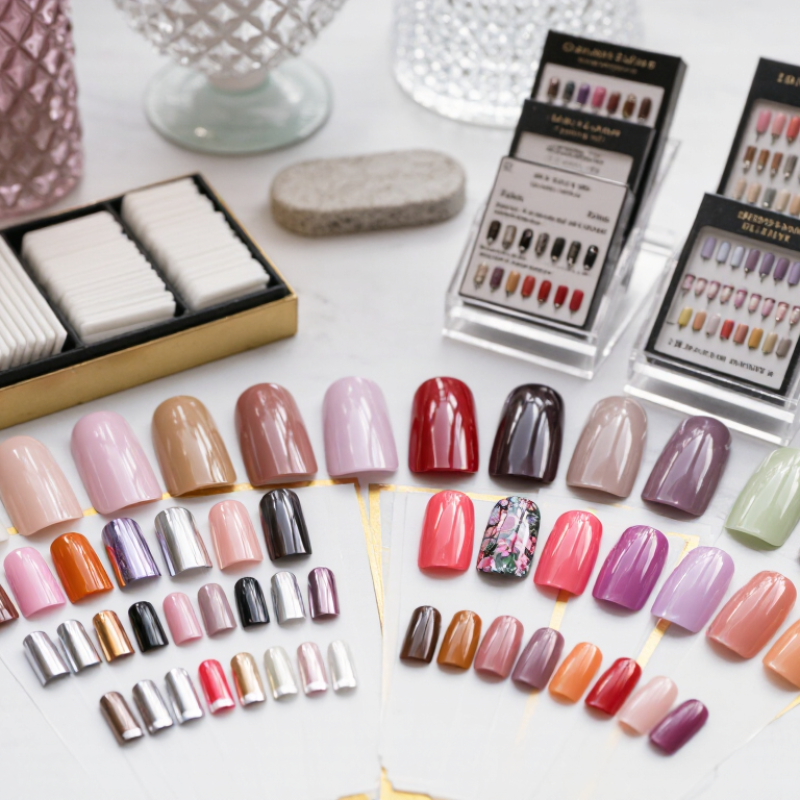
Acrylic Press-On Nail Basics and Key Buying Terms
2026 Top Acrylic Press-On Nails Types for Global Buyers
Acrylic press-on nails are ready-made enhancements shaped for quick, consistent application. “Acrylic” may describe the material, not salon-built acrylic powder. Buyers should confirm the substrate, thickness, finish, and adhesive method before ordering.
Grand View Research reported that the global artificial nails market was valued at about USD 1.32 billion in 2023, with continued growth projected through 2030. This supports stronger demand for clear product terminology.
Key buying terms include full-cover, short, medium, long, square, almond, coffin, C-curve, apex, sizing kit, glue tabs, and liquid adhesive. Full-cover tips need accurate sidewall contact. A visible gap can cause lifting.
Medium lengths often balance appearance and daily handling. Long shapes look dramatic, but they may reduce typing comfort. I have found sizing kits more reliable than guessing from photos. Still, finger width varies, and one sizing chart cannot fit everyone.
Tips:
Request exact measurements in millimetres, including the widest point. Check whether the set contains ten, twenty-four, or more pieces. Confirm adhesive ingredients, storage conditions, and stated wear time.
A 2024 market analysis from Grand View Research identifies convenience and at-home beauty use as important demand factors. Yet wear-time claims are not universal.
Preparation, nail curvature, humidity, and application pressure change results. Buyers should test one set before placing a larger order.
Small details matter.
Main Acrylic Press-On Nail Types for Global Buyers
Global buyers are choosing acrylic press-on nails by shape, length, structure, and finish. Grand View Research estimated the global artificial nails market at about USD 1.39 billion in 2023. Its report also projects steady growth through 2030. Market definitions differ, so this figure should guide planning, not replace local sales data.
The main type is the full-cover acrylic press-on nail. Short round and soft-square designs suit office wear, travel, and smaller nail beds. Medium almond and coffin shapes create a more styled appearance. Long coffin nails offer more visual impact, but they can feel less practical during typing or manual work. Clear, nude, French-style, glossy, matte, and chrome-like finishes serve different customer preferences. Buyers should check the apex, sidewall balance, and curvature. A thin tip may look elegant but can flex too easily.
Adhesive tabs support quick, temporary use. Liquid nail glue usually provides stronger wear, but customers need clear application instructions and safe removal guidance. The Business Research Company has reported continued expansion in the broader nail care products market, supported by at-home beauty routines and online retail. However, acrylic press-on demand is not identical across countries. Climate, nail-bed shape, sizing habits, and workplace expectations can change returns. I have also found that “universal fit” is often an overstatement. A practical range should include multiple sizes, measured in millimeters, with spare pieces for uneven nails.
Shape, Length, Finish, and Design Selection Guide
For global buyers, acrylic press-on nails should be selected by shape, length, finish, and design together.
Grand View Research valued the global nail care products market at approximately USD 23.57 billion in 2023. Its forecast also indicates steady growth through 2030. This supports demand for convenient, visual nail products, but trends cannot replace wear testing.
Short round and squoval shapes suit daily work and smaller nail beds. Medium almond creates a softer, lengthened appearance. Coffin and stiletto shapes deliver stronger visual impact, yet they need careful sizing and secure application. In professional sampling, extra-long styles often receive attention but show higher breakage risk. They are not always the best repeat-purchase option.
Finish changes the product’s perceived value. Glossy surfaces emphasize color depth, while matte coatings create a quieter, modern effect. Metallic, chrome, jelly, and glazed finishes require even coverage and clean edges.
Data from Circana’s 2024 beauty industry reporting showed continued consumer interest in at-home beauty routines, making easy application increasingly important. Design should match the finish. Minimal lines work well on short nails; raised charms need stronger packaging protection. I would also question oversized decorations, because they can reduce comfort during typing and shipping stability. Sample tests should check curvature, adhesive fit, edge thickness, removal comfort, and performance across different climates.
Quality, Sizing, Durability, and Safety Considerations
Global buyers now compare more than color and shape. Grand View Research valued the global artificial nails market at about USD 1.32 billion in 2023. It also projects roughly 4.8% annual growth through 2030. Acrylic press-ons should have even edges, consistent thickness, and a smooth cuticle line. Thin tips may look elegant, but they can crack during shipping. A slightly flexible structure often survives repeated daily movement better. Fit comes first. Each set should include varied widths, not just longer extensions. Measure the widest part of each natural nail, then compare millimeters with the supplier’s chart. A perfect chart still fails when nail curvature changes.
Durability depends on preparation, adhesive quality, and storage temperature. In practical sample checks, lifting often appears near the sidewalls before the center fails. Buyers should test several hand sizes and record wear after washing, typing, and opening packages. Seven to fourteen days is a useful target, not a promise. Manufacturing records should identify the material, batch, curing guidance, and recommended shelf life. Details matter. Acrylic descriptions can be unclear, because some “acrylic” press-ons use different plastics or surface coatings.
Safety needs equal attention. The U.S. Food and Drug Administration explains that cosmetics generally do not receive premarket approval, except for color additives. Therefore, suppliers must provide complete ingredient and warning information. Adhesives containing cyanoacrylate may irritate skin or eyes, especially after accidental contact. Products should not cover infected, broken, or inflamed nails. Patch testing helps, but it cannot predict every reaction. One uncomfortable lesson remains: attractive packaging can hide weak documentation. Global buyers should verify test reports, labeling languages, and regional chemical requirements before scaling an order.
2026 Top Acrylic Press-On Nail Types for Global Buyers: Quality, Sizing, Durability, and Safety Considerations
| Nail Type | Typical Length | Shape Characteristics | Recommended Use | Material and Finish Quality | Typical Fit and Sizing Notes | Expected Wear Time* | Durability Profile | Safety and Comfort Considerations | Buyer Quality Check |
|---|---|---|---|---|---|---|---|---|---|
| Short Round | 8–12 mm beyond the natural nail edge | Compact length with a curved free edge; low snag risk. | Daily office wear, school, healthcare environments, and first-time users. | Rigid ABS or acrylic-style plastic with a smooth, even surface; glossy and matte finishes are common. | Usually the easiest shape to fit. Check width at the widest point of each natural nail rather than relying only on a standard size label. | 5–10 days | Good resistance to normal typing and light household activity; less leverage than long styles. | Generally comfortable when the sidewalls do not press into the skin. Avoid forcing a smaller tip onto a wider nail. | Look for a consistent curve, thin but strong edges, clean cuticle lines, and no visible bubbles or warping. |
| Short Square | 8–13 mm beyond the natural nail edge | Straight sidewalls and a squared free edge; structured appearance. | Professional settings, practical everyday wear, and users preferring a neat geometric look. | Firm construction is important because square corners can receive more impact; surface decoration should be sealed evenly. | Best for nails with moderate-to-wide nail beds. Sidewalls should align without extending over the skin. | 5–10 days | Good overall strength, although corners may chip if the tip is too long or catches on hard surfaces. | Round or softly filed corners can improve comfort and reduce snagging. Remove carefully instead of lifting forcefully. | Inspect corners, sidewall symmetry, adhesive compatibility, and whether the underside is smooth enough for full contact. |
| Medium Oval | 13–18 mm beyond the natural nail edge | Balanced length with tapered sides and a rounded tip. | Versatile retail assortments, formal events, and buyers wanting an elegant but wearable silhouette. | Requires a balanced combination of flexibility and rigidity; an even apex helps distribute impact. | Often suits narrow-to-medium nail beds. Measure all ten nails because left and right hands are not always identical. | 5–10 days | Moderate-to-good durability when the tip is properly sized and bonded across the full nail plate. | More comfortable than sharply pointed shapes, but length can still interfere with manual work or contact sports. | Check that the curve follows the natural nail without large air gaps and that the tip does not rock after placement. |
| Medium Almond | 14–20 mm beyond the natural nail edge | Tapered sides with a softly pointed, rounded tip; visually lengthening. | Fashion collections, occasion wear, and customers seeking a refined silhouette. | A smooth transition from the apex to the tip is essential. Thin pointed ends should not be brittle or uneven. | Usually fits narrow-to-medium nail beds. The widest section must match the natural nail without side pressure. | 5–8 days | Good flexibility and appearance, but the tapered tip is more vulnerable to bending than short round styles. | Use a moderate length for active users. Do not use a damaged or split tip, as sharp edges may scratch the skin. | Check tip alignment, consistent tapering, smooth edges, and resistance to light flexing without cracking. |
| Long Coffin | 20–30 mm beyond the natural nail edge | Long tapered sides ending in a straight free edge; high-impact fashion profile. | Special occasions, editorial designs, salon-style collections, and customers comfortable with extended length. | Needs a strong central structure and a well-sealed design layer. Excessively thin long tips are more likely to bend or snap. | Requires accurate sizing and careful placement. A tip that is too narrow can create side pressure and premature lifting. | 3–7 days | Higher leverage makes this style more susceptible to impact damage, lifting, and breakage during manual tasks. | Not ideal for intensive work, young children, or users with weak or peeling natural nails. Keep away from excessive force. | Evaluate the apex, sidewall thickness, straightness of the free edge, and the strength of the decorative coating. |
| Long Stiletto | 22–35 mm beyond the natural nail edge | Strongly tapered sides with a sharp point; dramatic visual effect. | Costume use, photo shoots, performance styling, and limited-duration event wear. | Needs a reinforced structure and a smooth, securely sealed point. The sharp tip must be free from cracks and rough plastic. | Fit is demanding because the narrow tip and high curve can cause pressure if the base is not matched correctly. | 2–5 days | Lowest practical durability among common shapes because the point concentrates impact and creates high leverage. | Use with caution around children, pets, fabrics, and manual activities. Avoid wearing when the point is cracked or deformed. | Check point symmetry, base curvature, edge smoothness, structural reinforcement, and secure packaging protection. |
| Short Squoval | 9–14 mm beyond the natural nail edge | Square profile with softened corners; combines structure with reduced snagging. | Mass-market collections, travel, everyday wear, and customers wanting a low-maintenance shape. | Consistent thickness and a smooth transition around the softened corners improve both appearance and service life. | Suitable for many medium-width nail beds. A complete ten-size range improves fit across international customer groups. | 5–10 days | Good balance of strength, comfort, and resistance to corner damage. | Soft corners are generally more comfortable, but correct sizing and gentle removal are still necessary to protect the natural nail. | Confirm uniform sizes, accurate labeling, smooth edges, stable color, and full adhesive contact after application. |
*Wear-time note: The stated wear ranges are practical estimates for properly prepared natural nails, correctly matched sizes, suitable adhesive, and normal daily activity. Actual performance varies with nail condition, application technique, moisture, temperature, occupation, and removal method.
General safety note: Buyers should request material declarations, adhesive ingredient information, batch traceability, safety documentation, and applicable market compliance records before commercial distribution. Users should stop wearing the product if irritation, pain, discoloration, or lifting with trapped moisture occurs.
Packaging, Customization, Compliance, and Supplier Evaluation
For global buyers, acrylic press-on nails should match both fashion demand and daily wear.
Short square styles suit retail basics, while almond and coffin shapes support trend-led collections. Full-cover nails need consistent curvature, smooth edges, and balanced thickness. I recommend testing several sizes on real hands before approving bulk production. A beautiful sample can still feel uncomfortable after two hours.
Packaging requires practical customization.
Use recyclable cartons, secure inner trays, and size labels that remain readable after shipping. Custom colors, printed inserts, nail counts, and adhesive options can strengthen a private-label collection. However, packaging claims must be accurate. Product labels should identify materials, usage instructions, warnings, country requirements, and responsible business information where applicable. Compliance rules differ across markets, so buyers should confirm current requirements with qualified local specialists. Documentation matters.
Tips:
Request pre-production samples, packaging mockups, material declarations, and batch photographs. Ask suppliers how they control thickness, color consistency, sizing, and damaged units. Compare MOQ, lead time, replacement policy, and inspection procedures. A supplier that answers quickly may still lack reliable controls. I learned that late quality checks create expensive delays. Put acceptance standards in writing before payment and production. Also test cartons under realistic transport conditions; attractive packaging is not enough if corners arrive crushed.