

7 Best Home Energy Storage Batteries for 2026
A Home Energy Storage Battery can keep essential circuits running when the grid fails, store midday solar power, and reduce evening electricity purchases. The right choice depends on more than advertised capacity. Usable energy, continuous output, chemistry, warranty terms, and compatibility with your inverter all matter.
The International Energy Agency reported that global battery storage additions reached about 42 gigawatts in 2023, more than double the previous year. Its 2024 report, Batteries and Secure Energy Transitions, also says battery storage must scale rapidly to support clean-energy goals. These figures describe the wider market, not household sales. Still, they show why home battery options are expanding—and why product claims deserve careful checking.
Real homes have limits. A garage wall may not fit a large battery, and a high-capacity unit may not power a heat pump and an oven at once. Backup needs differ. Prices, installation requirements, and local electricity rates also change the value of a system. This guide compares seven leading options for 2026, focusing on practical specifications and trade-offs rather than a single “best” choice. Product availability and warranties can change, so verify current details with manufacturers and qualified installers. Some comparisons remain imperfect: published ratings cannot fully predict performance in every home.
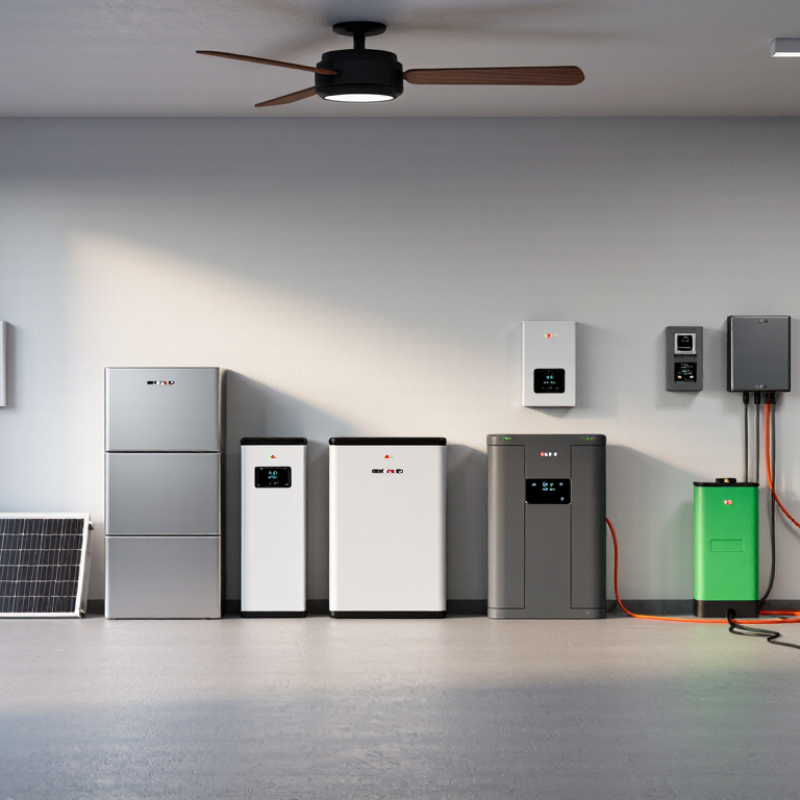
How Home Energy Storage Batteries Work
A home energy storage battery keeps electricity for use later. Most systems store energy as direct current inside battery cells. Solar panels produce direct current too, while household outlets use alternating current. An inverter converts power between these forms. During sunny hours, extra solar electricity can charge the battery instead of flowing back to the grid. At night, the inverter sends stored energy to selected circuits or the whole home, depending on system design.
A battery management system tracks cell voltage, temperature, and charge level. It helps keep the cells within safe operating limits and may reduce charging when conditions are too hot or cold. If the grid goes down, some systems can disconnect from it and supply backup power. Not every system does this automatically. A fridge, a few lights, and a router use less stored energy than electric heating or cooking, so backup time depends on both battery capacity and household demand. Conversion also loses some energy. That detail is easy to overlook. Actual performance varies with equipment, installation, weather, and how often the battery is cycled. A small display may show a precise percentage, but that number is still an estimate.
7 Best Home Energy Storage Batteries for 2026 – How Home Energy Storage Batteries Work
| Storage Option | Typical Usable Capacity | Typical Continuous Output | Typical Round-Trip Efficiency | Common Warranty Term | Best Suited For | How It Works |
|---|---|---|---|---|---|---|
| Compact lithium iron phosphate (LFP) battery | About 5–8 kWh per unit | About 2–5 kW | About 90–96% (system design dependent) | Often around 10 years | Small homes, essential-load backup, or households starting with a modest battery | Stores electricity as chemical energy and supplies it through an inverter when solar production is low or the grid is unavailable. |
| Standard modular LFP battery | About 10–15 kWh per unit or system | About 5–10 kW | About 90–96% (system design dependent) | Often around 10 years | Typical homes seeking evening energy use and backup for selected circuits | Multiple battery modules can be managed together; an inverter controls charging, discharging, and power conversion. |
| High-output LFP battery | About 10–16 kWh per unit | About 7–11 kW | About 90–96% (system design dependent) | Often around 10 years | Homes with brief high-power demands, such as starting pumps or running several appliances together | Its power rating describes how quickly it can deliver electricity; usable capacity describes how much energy it can store. |
| Expandable multi-unit LFP system | About 20–40 kWh when configured with multiple units | About 10–20 kW, depending on inverter and configuration | About 90–96% (system design dependent) | Often around 10 years | Larger homes, higher daily consumption, or longer backup needs | Additional battery modules increase stored energy; the inverter and electrical system must also support the combined power and capacity. |
| AC-coupled LFP retrofit system | About 5–15 kWh per battery unit | About 3–10 kW, depending on inverter | About 85–92% for a full AC-coupled charge-and-discharge path | Often around 10 years | Homes adding storage to an existing solar installation | Solar electricity is converted to AC and then converted again for battery storage; this can simplify some retrofits but adds conversion steps. |
| DC-coupled LFP system with a hybrid inverter | About 5–20 kWh, depending on battery configuration | About 5–12 kW, depending on inverter | About 90–97% for the DC battery path; whole-system results vary | Often around 10 years | New solar installations designed to connect panels and battery storage through a compatible hybrid inverter | Solar power can charge the battery on the DC side before conversion to AC, reducing conversion steps on some operating paths. |
| Compact high-energy-density lithium-ion battery | About 5–13 kWh per unit | About 2–7 kW | About 85–95%, depending on chemistry and system design | Commonly around 10 years; check the specific warranty | Installations where compact size or a particular existing system’s compatibility is a priority | Stores electricity electrochemically like other lithium-ion batteries. Chemistry, operating limits, warranty conditions, and inverter compatibility vary by system. |
How to read these figures: Values are indicative ranges drawn from commonly published residential-system specifications, not guarantees for every product. Capacity, output, efficiency, cycle-life claims, and warranty coverage vary by model and test conditions. Backup operation may require a compatible inverter, transfer equipment, and installation; a battery alone does not necessarily provide whole-home backup.