

7 Best Hand Made Cleanroom Panels for Global Buyers
A cleanroom panel is more than a wall. It helps control particle movement, supports routine cleaning, and protects the performance of the whole room. For global buyers, choosing a Hand-Made Cleanroom Panel means weighing core material, surface finish, joint design, fire performance, and supplier quality. Details matter. A poorly sealed joint can become a weak point, even when the panel itself looks flawless.
ISO 14644-1:2015 provides a useful reference for the conditions these spaces must support. Its particle concentration limits allow no more than 3,520 particles per cubic metre at or above 0.5 micrometres in an ISO Class 5 environment. For ISO Class 7, the limit at that particle size is 352,000 per cubic metre. These figures describe room cleanliness, not panel performance alone. Air handling, installation, operator practices, and ongoing testing all affect the result. Buyers should treat panel specifications as one part of a verified cleanroom system.
This guide compares seven hand-made cleanroom panel options for different project needs, from pharmaceutical production to electronics assembly. It considers measurable specifications alongside practical details, such as how easily a surface can be wiped around corners and seams. No single panel fits every facility. Some trade-offs are easy to miss in a datasheet. Review test documents, ask how panels are made, and check whether the proposed design suits the room’s classification and operating conditions. ISO 14644-4:2022 also offers guidance on cleanroom design and construction, but the final choice still requires project-specific review.
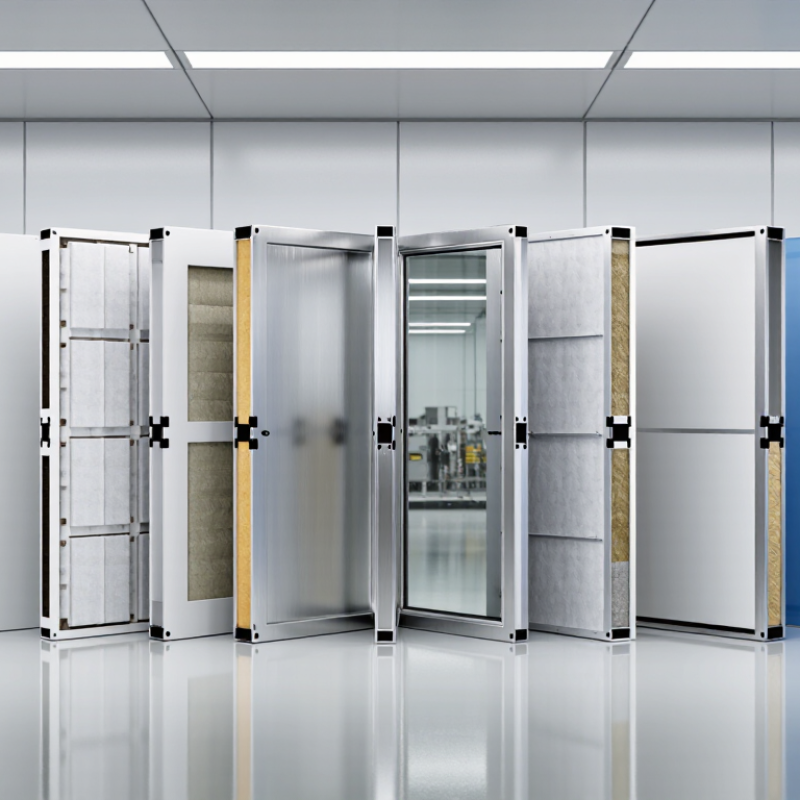
What Handmade Cleanroom Panels Are and Where They Are Used
Handmade cleanroom panels are wall or ceiling modules cut and assembled to suit a project’s dimensions and layout. Workers typically join metal facings to an insulated core, then seal edges and prepare openings for doors, windows, or service lines. The result is a fitted building component, not a cleanroom by itself. Fit matters. Small gaps around panel joints can collect dust or weaken pressure control.
These panels are used in pharmaceutical production, medical-device assembly, electronics manufacturing, laboratories, and other controlled environments. Their smooth surfaces support cleaning, while sealed connections help limit particle migration. Actual performance depends on panel materials, joint details, installation quality, and the room’s air-handling and monitoring systems. ISO 14644-1 classifies cleanrooms by airborne particle concentration; panels alone cannot establish a room’s classification. Grand View Research estimated the global cleanroom technology market at about USD 6.8 billion in 2023, with projected growth of 5.4% annually from 2024 to 2030. That market estimate reflects wider demand, not handmade panels specifically. Buyers should check drawings, core and facing specifications, fire-performance documentation, and installation tolerances. Handmade does not always mean more precise; workshop methods and quality checks vary. Sources: Grand View Research, Cleanroom Technology Market Size, Share & Trends Analysis Report, 2024–2030; ISO 14644-1.
How Handmade Cleanroom Panels Are Designed and Manufactured
Handmade cleanroom panels begin with the room’s actual requirements, not a standard sheet size. Designers check ceiling height, wall layout, door openings, service routes, and expected cleaning methods. They then select suitable face sheets, a core, and edge details. The exact combination depends on the project. A panel may look simple, but a poorly planned joint can collect dust or complicate installation.
In production, workers cut the face sheets and core to measured dimensions, assemble the layers, and bond them under controlled pressure. After curing, they trim edges and prepare openings for windows, conduits, or other fittings. Each cut needs care. Small variations can affect alignment across a long wall. Inspectors should check dimensions, surface condition, bond quality, and joint fit. Where cleanliness or fire performance is specified, buyers should verify the relevant test records rather than rely on appearance alone. Handmade does not automatically mean better; workmanship and documented checks matter.
Tips: Share drawings and service locations before fabrication. Ask how the supplier controls flatness, protects finished surfaces, and records inspections. Confirm that panel materials suit the planned cleaning agents. A detail often missed: clarify who verifies measurements on site. It can prevent avoidable rework, though measurements may still need adjustment when existing walls are uneven.
Cleanroom Panel Design Starts with the Required Cleanliness Class
ISO cleanroom classification sets maximum airborne particle concentrations that help define a project’s cleanliness requirements. These limits can inform handmade panel design, including surface finish, joint details, and sealing. They are room classification limits—not a performance rating for the panels themselves.
Reference: ISO 14644-1:2015. Maximum concentration of particles ≥0.5 μm per cubic metre of air.
Seven Handmade Cleanroom Panel Types for Global Buyers
Handmade panels are assembled to project dimensions, so core, facing, and joint details matter. Common choices include color-coated steel with EPS, rockwool, or polyurethane cores; galvanized steel with paper honeycomb; aluminum with aluminum honeycomb; stainless steel with mineral wool; and magnesium-oxide board with a rockwool core. That makes seven distinct constructions. Each balances weight, insulation, fire performance, moisture resistance, and cost differently. Details matter.
EPS panels are lightweight, while rockwool-core options are selected when fire performance is a priority. Polyurethane offers strong thermal insulation, but buyers should check fire-test documentation for the complete panel assembly. Honeycomb cores reduce weight and can suit partitions, though edge sealing and load requirements need careful review. Stainless-steel facings resist corrosion in demanding washdown areas. Magnesium-oxide boards may suit projects seeking a rigid, non-metallic surface; verify moisture behavior and finish compatibility with suppliers. A clean-looking seam is not proof of a cleanable, airtight joint.
Grand View Research’s 2023 Cleanroom Technology Market report estimated the global market at USD 5.3 billion in 2022 and projected 5.8% annual growth through 2030. That growth makes specification discipline more important, not less. ISO 14644-1:2015 classifies cleanrooms by airborne particle concentration; panel selection alone cannot establish room classification. Buyers should request core-density records, facing thickness, fire-test results, and details for corners, doors, and service penetrations. One trade-off is easy to miss: a cheaper panel may require more careful joint finishing on site.
7 Best Hand Made Cleanroom Panels for Global Buyers - Seven Handmade Cleanroom Panel Types for Global Buyers
A practical comparison of common cleanroom panel constructions. “Handmade” generally describes a manufacturing method; actual performance depends on the complete panel assembly, installation, and tested specifications.
| Panel type | Typical construction | Key characteristics | Potential applications | Buyer checks |
|---|---|---|---|---|
| EPS-core panel | Metal sheet facings bonded to an expanded polystyrene (EPS) core. | Lightweight and commonly selected for cost-conscious projects. EPS is combustible, so fire performance must be assessed for the full assembly. | Enclosures and support areas where project requirements permit this core. | Confirm fire-test evidence, joint details, facing material, and compatibility with cleaning agents. |
| Mineral-wool-core panel | Metal facings with a stone-wool or other mineral-wool insulation core. | Mineral-wool products are generally non-combustible; the panel’s fire rating still depends on its complete tested construction. | Projects that place emphasis on fire performance, subject to local code and assembly test results. | Request applicable fire-test reports, density and thickness data, and details for sealed edges and joints. |
| Glass-wool-core panel | Metal facings enclosing a glass-wool insulation core. | Provides thermal and acoustic insulation. Performance varies with core specification, panel thickness, and workmanship. | Partitions where insulation and sound control are relevant and the specified assembly meets project requirements. | Check fire classification, core containment, dimensional tolerances, and the finish’s cleanability. |
| PU/PIR-core panel | Metal facings bonded to a rigid polyurethane (PU) or polyisocyanurate (PIR) foam core. | Rigid foam cores can provide effective thermal insulation at relatively low weight. Fire behavior differs by formulation and assembly. | Temperature-controlled rooms and partitions where insulation performance is an important design factor. | Compare declared thermal data, fire-test documentation, facing adhesion, and temperature limits. |
| Paper-honeycomb-core panel | Metal facings bonded to a paper honeycomb structure. | Lightweight cellular construction can offer useful stiffness for its mass. Paper cores require protection from moisture and are combustible. | Dry interior partitions where lightweight construction is suitable and fire requirements are satisfied. | Verify edge sealing, moisture exposure limits, load requirements, and the applicable fire classification. |
| Aluminum-honeycomb-core panel | Metal facings bonded to an aluminum honeycomb core. | A lightweight cellular panel that can provide high stiffness when properly designed. It is not, by itself, a guarantee of a particular fire rating. | Applications requiring a lightweight, rigid partition or panel system. | Review bonding method, point-load limits, corrosion compatibility, and tested fire performance. |
| Magnesium-oxide-board panel | Metal facings combined with magnesium oxide (MgO) board layers or a board-based core. | Offers a rigid board-based construction. Moisture behavior and product composition vary; board designation alone does not establish panel fire performance. | Projects requiring a board-faced partition, where the selected product is suitable for the site environment. | Request product-specific composition, moisture and corrosion data, and test reports for the complete panel assembly. |
Note: Panel dimensions, metal facing thickness, core properties, fire classifications, and available finishes vary by supplier and destination market. Confirm the required standards, test documentation, joint system, and cleaning-chemical compatibility before purchase.
How to Compare Panel Materials, Performance, and Compliance
Hand-made cleanroom panels should be compared by their materials, construction, and documented performance, not appearance alone. Steel-faced panels are durable and easy to wipe, while aluminum can reduce weight. The best choice depends on the room’s cleaning routine, humidity, and impact risks. Small details matter. Look closely at corners, joints, and cut edges, where gaps may collect dust or allow moisture to enter.
Core material affects fire behavior, insulation, and panel weight. Mineral wool and polymer cores have different performance profiles, so request product-specific test data rather than relying on broad claims. Ask how panel thickness and joint design affect air leakage and structural stability. A smooth sample helps, but it cannot show how every panel will be made. I would not treat a neat sample as proof of consistent production.
For compliance, match test reports to the project specification and intended cleanroom class. Check what was tested, by whom, and under which method; panel data alone does not certify an entire room. Confirm applicable fire, emissions, and hygiene requirements with the project team, since local rules and site conditions vary. Handmade production may need tighter inspection records. That takes time. Review dimensional tolerances, batch traceability, and inspection procedures before comparing prices. A low-cost panel can become expensive if joints need rework or cleaning access is awkward.
What to Check When Sourcing Panels for International Projects
For international projects, a cleanroom panel must fit the building, process, and destination requirements. Ask suppliers for panel drawings showing thickness, usable width, joint details, and permitted tolerances. A few millimeters can affect door openings or ceiling grids. Check the core and facing materials against the project’s fire, thermal, and moisture requirements. Do not assume one specification suits every facility.
Request finish samples and inspect them under bright, angled light. Small dents, uneven coating, or rough edges are easier to spot before shipment. Hand-made panels can vary between batches, so ask how dimensions and appearance are checked. A full-size corner mock-up is useful. It may feel like extra work, but it can reveal awkward joints that a small swatch cannot.
Confirm the documents needed at the destination, including test reports, material data, packing lists, and installation instructions. Standards and accepted test methods can differ by market; have the project team verify the applicable requirements rather than relying on a generic certificate. Clarify packaging, moisture protection, labeling, and replacement-part arrangements in writing. Long-distance shipping adds handling risks. Even careful packaging is not perfect, so agree on how damaged panels will be recorded and assessed when they arrive.