

10 Best Wooden Maze Toys for Kids in 2026
A wooden maze can turn a quiet moment into hands-on play. Children guide bright beads along winding tracks, pause at tight corners, and try again when a path feels tricky. These small actions invite practice with hand control, visual tracking, and patience. They are not a substitute for open-ended play, though. Some children enjoy solving every route; others lose interest after a few minutes.
This guide to the 10 Best Wooden Maze Toys for Kids in 2026 helps families compare designs before choosing one. It considers age guidance, maze complexity, bead size, base stability, and how easily a toy fits on a table or travels in a bag. Check the maker’s care instructions and inspect the toy for loose parts or rough edges before use. Adult supervision matters, especially for younger children. A smooth finish is useful, but it does not tell the whole story. Wood grain, paint, and construction can vary, even between similar-looking products. Searches may describe these products with the phrase “Maze Wooden,” but a keyword cannot tell you whether a particular toy suits your child. Look closely at dimensions and age recommendations. Small details count. The best choice is not always the most elaborate one; a simpler track may be easier for little hands to enjoy.
What Wooden Maze Toys Are and How They Support Learning
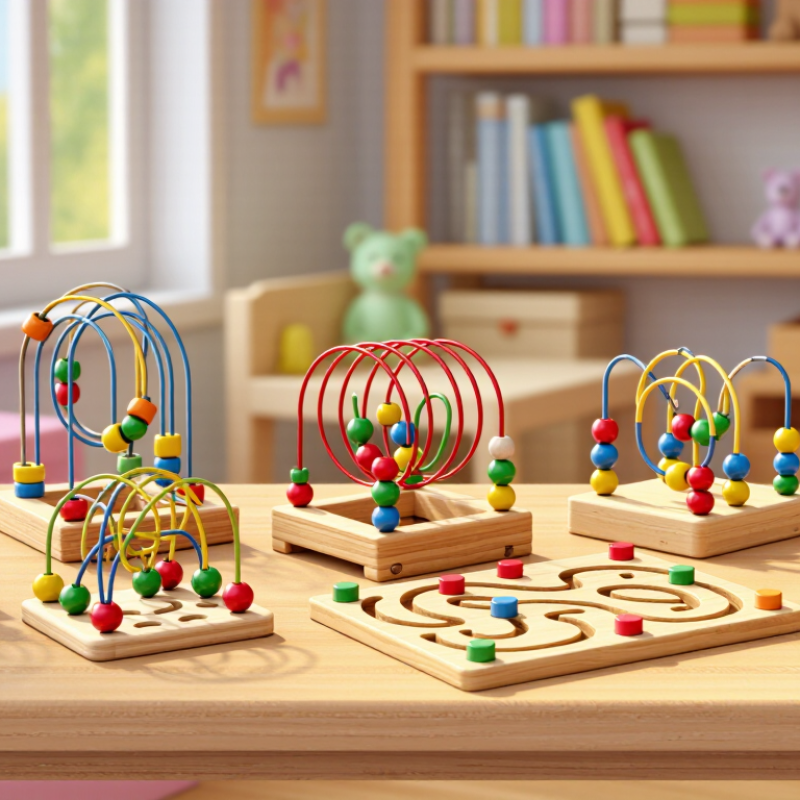
A wooden maze toy is a board or frame with pathways that guide a bead, ball, or sliding piece from one point to another. Some designs use a stylus, while others have beads attached to curved wires. Children move each piece by hand, watching how small turns change its path. It looks simple. The task can still require patience and control.
Following a route helps children practice hand-eye coordination, finger movements, and visual tracking. Choosing a direction also introduces early problem-solving and spatial thinking. An adult might ask, “Which way could the bead go now?” These conversations can build useful language without turning play into a test. Results vary, of course; a maze toy does not teach every child in the same way. Some children may enjoy repeating one familiar route more than exploring new ones, and that is worth noticing.
Tips: Choose a maze suited to the child’s age, with securely attached pieces and smooth edges. Sit nearby at first, and let the child set the pace. If frustration rises, offer a hint rather than moving the piece for them.
Key Safety, Material, and Design Features to Compare
When comparing wooden maze toys, inspect the bead size, track openings, and finish—not just the age label. Small beads can detach after rough play. Check joints for splinters, gaps, and loose screws. The U.S. Consumer Product Safety Commission estimated 231,700 toy-related emergency-room injuries in 2023; that figure covers toys broadly, not wooden mazes alone. It is a useful reminder to examine construction and supervise young children.
Material claims need scrutiny. “Natural wood” does not automatically mean durable or well-finished. Look for smooth edges, firmly bonded pieces, and coatings that do not flake when rubbed with a clean cloth. For added reassurance, check whether the toy has been tested to ASTM F963, a U.S. toy-safety standard covering hazards such as small parts and surface coatings. Testing claims should identify the standard, not rely on vague words like “safe.”
Design affects both play and safety. A wide, stable base is less likely to slide as a child guides the bead. Tracks should feel smooth, with no sharp turns that trap fingers. Simple layouts suit beginners; older children may enjoy branching paths and smaller targets. Try the maze yourself. Some designs look clever but frustrate little hands, and that trade-off is easy to miss in product photos.
How to Choose a Maze Toy for a Child’s Age and Skills
A wooden maze toy should match a child’s current abilities, not just their age. For toddlers, choose a sturdy, enclosed design with large, easy-to-grip pieces and a simple path. Check the maker’s age guidance, especially if the toy includes small beads or movable parts. Older preschoolers may enjoy branching routes, tighter turns, or more than one moving piece. School-age children often welcome puzzles that require planning several moves ahead. A maze that feels too difficult can quickly become shelf decor.
Tips: Watch how the child plays. Do they guide a bead steadily, or lose patience at narrow corners? Look for smooth edges, secure parts, and a board that stays flat on a table. Supervise younger children, and check the toy regularly for loose pieces or splinters. Short play sessions can help a beginner build confidence.
Difficulty is not always easy to judge from a product photo. I sometimes overestimate how much challenge a child will enjoy; a colorful, complicated maze can still frustrate them. Let the child try a few routes before adding hints. If they solve the path easily, choose a more complex layout next time. If they repeatedly get stuck, return to a simpler route. The right fit may change within a few months.
| # | Maze Toy Style | Suggested Age Range | Typical Challenge | Skills Practiced | What to Look For | Good Match For |
|---|---|---|---|---|---|---|
| 1 | Large-bead wire maze on a wooden base | 1–3 years | Move large beads along fixed, curved wires | Hand-eye coordination, grasping, visual tracking | A stable, wide base; securely attached wires; beads too large to present a choking hazard | Young toddlers beginning to explore simple cause and movement |
| 2 | Wooden bead-and-wire activity cube | 1–3 years | Guide beads across a compact route, often alongside other simple activities | Fine motor control, reaching, turn-taking | Smooth edges, a sturdy construction, and age guidance that accounts for any small accessories | Children who enjoy varied activities at a table or on the floor |
| 3 | Magnetic-wand maze board | 3–5 years | Use a wand to move a captive metal ball through a printed or routed path | Controlled hand movements, focus, path following | A securely attached wand and ball; check the maker’s age label and inspect for damage | Preschoolers practicing steady, deliberate movements |
| 4 | Handheld enclosed ball maze | 3–6 years | Tilt the board to guide a ball through turns and around obstacles | Patience, wrist control, spatial reasoning | A securely closed cover and a ball that cannot be accessed during normal play | Children who like independent, hands-on puzzles |
| 5 | Two-sided wooden maze board | 4–7 years | Complete different paths on opposite sides of the board | Planning, visual scanning, persistence | Clearly differentiated routes and a difficulty level suited to the child’s current experience | Children ready to try more than one route or puzzle in a session |
| 6 | Sliding-block maze puzzle | 5–8 years | Move wooden pieces through a grid to create or clear a route | Problem-solving, sequencing, flexible thinking | Pieces that slide smoothly without excessive looseness, plus clear instructions if the puzzle has set challenges | Children who enjoy planning moves before acting |
| 7 | Wooden maze with gates and movable barriers | 5–8 years | Open and close barriers in the correct order while guiding a ball or token | Cause and effect, sequencing, concentration | Barriers that move easily and remain attached; avoid pieces that are loose or damaged | Children who are ready for puzzles with multiple steps |
| 8 | Numbered or lettered path maze | 5–8 years | Follow a route using a simple number, letter, or symbol sequence | Early literacy or numeracy practice, attention, tracking | Large, legible markings and a route that does not rely on skills the child has not yet learned | Children who enjoy combining puzzle play with familiar symbols |
| 9 | Three-dimensional wooden ball maze | 6–9 years | Guide a ball through ramps, tunnels, or levels in a multi-layer route | Spatial reasoning, motor planning, persistence | A stable structure, securely joined parts, and a ball that stays within the intended track | Older children who want a longer or more complex challenge |
| 10 | Customizable wooden maze kit | 7 years and up | Arrange pieces to build a route, then test and revise the design | Design thinking, creativity, trial and error | Parts sized and finished for the stated age range, with clear assembly and supervision guidance | Children who like building, experimenting, and making their own puzzles |
10 Best Wooden Maze Toys for Kids in 2026
A 2026 guide to the 10 best wooden maze toys should compare more than bright colors. Look for a stable base, smooth edges, securely enclosed beads, and paths that challenge without frustrating. Useful choices include a simple wire track, a tilting labyrinth, a wooden maze cube, a tabletop board, and designs featuring numbers, letters, or familiar scenes. Double-sided boards can offer two difficulty levels in one toy. Small details matter. Check age guidance and inspect moving parts regularly, especially when younger children share the play area.
Safety deserves space in any careful selection. The U.S. Consumer Product Safety Commission’s 2023 toy injury report estimated 231,700 emergency-department-treated injuries involving toys among children aged 14 and younger. That figure covers toys broadly, not wooden mazes specifically, but it supports checking construction and age suitability rather than assuming wood means risk-free. For play value, choose paths that invite repeated attempts and allow a child to move beads without constant adult help. A maze that is too easy may lose its appeal; one that is too difficult may end up untouched. That balance is imperfect, and children differ. A thoughtful shortlist should include beginner, intermediate, and more intricate layouts, with clear descriptions of bead size, board dimensions, and maze complexity.
10 Best Wooden Maze Toys for Kids in 2026
How to read this chart: These percentages are a suggested editorial framework for comparing wooden maze toys, not product test results or market statistics. Prioritize age suitability, challenge level, build quality, and safety when choosing a toy.
Comparing Maze Types, Play Styles, and Ideal Uses
10 Best Wooden Maze Toys for Kids in 2026
Comparing Maze Types, Play Styles, and Ideal Uses
Wooden maze toys vary more than their simple paths suggest. Flat bead mazes invite children to push a piece along a track, while tilt mazes use small knobs or handles to guide a ball. Magnetic wand designs let players steer pieces beneath a clear surface. Each style feels different in the hands. A sturdy tabletop maze may suit quiet solo play, while a compact handheld one travels more easily. Some models have bright colors and branching routes; others keep the path simple. The best fit depends on a child’s age, patience, and interest—not just the number of turns.
For younger children, choose broad paths and easy-to-grip pieces. Older kids may enjoy tighter corners, multiple routes, or a timed challenge. A maze can encourage careful hand movements and problem-solving, but it may frustrate a child who wants quick results. That is worth considering. I would look for smooth edges, stable joints, and a surface that does not wobble during play. A beautiful finish alone tells little about durability.
Tips: Check the maker’s age guidance and inspect the toy for loose parts before play. Try the maze yourself; a ball that sticks at every turn can spoil the fun. Store magnetic wands and small pieces where very young children cannot reach them. For shared play, pick a design with enough space for two players to take turns without crowding.