

China Top 10 1500VA Rack Mount UPS Suppliers
Choosing a 1500VA rack-mount UPS involves more than comparing prices or advertised capacity. This guide introduces ten suppliers in China and the details buyers should examine before requesting a quotation. A 1500VA rating does not guarantee the same usable power or runtime across models. Check the stated wattage, output waveform, battery configuration, and performance at your expected load. Small differences matter.
Fit is practical, too. A unit may occupy 2U of a standard 19-inch rack, yet still need clearance for cables and ventilation. Ask suppliers for dimensional drawings, datasheets, warranty terms, and clear guidance on battery replacement. For critical equipment, confirm available monitoring options and how the supplier handles technical support after delivery. These checks are useful for servers, network cabinets, and other electronics, but the right specification depends on the actual load and operating conditions.
A ranking is only a starting point. Compare documentation, product consistency, communication, and service coverage—not just factory claims. Verify certifications against your destination market and the exact model being offered. If you search for “1500 Ups Rack Mount,” use the phrase as a starting point, then compare it with precise technical specifications. Some listings leave important details unclear. That is worth questioning. The suppliers covered here can help readers build a shortlist, but no list replaces sample evaluation, reference checks, and a careful review of the final quotation.
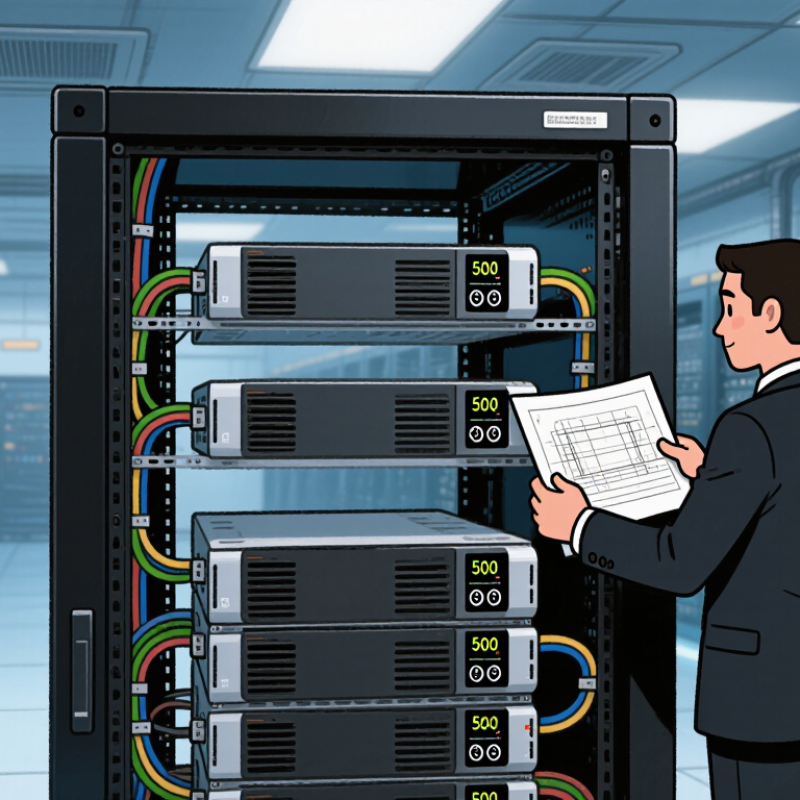
What Is a 1500VA Rack-Mount UPS and How Does It Work?
A 1500VA rack-mount UPS is a compact backup power unit designed to fit a server rack. Its 1500VA rating measures apparent power, not usable watts. At a 0.9 power factor, 1500VA corresponds to 1350W, but the UPS’s own watt limit may be lower. Check both ratings. The label can mislead.
During normal operation, the UPS supplies power and may regulate voltage. If mains power fails, its battery feeds an inverter, which provides AC power to connected equipment. Line-interactive models typically switch to battery during an outage; online double-conversion models continuously convert incoming power, usually avoiding a transfer delay. Runtime depends on load, battery condition, and temperature, so a full server rack may run for only minutes. Not hours.
The Uptime Institute’s 2024 Annual Outage Analysis reports that 54% of significant outages cost more than $100,000. That figure does not prove a small UPS prevents outages, but it shows why short-term backup and orderly shutdowns matter. IEC 62040-3 defines UPS performance and test requirements, giving buyers a useful reference beyond VA ratings. For a real installation, match the UPS’s watt capacity to measured equipment demand, and verify runtime at that load. Estimates are not guarantees.
How Are China’s Top 10 Suppliers Selected and Compared?
A credible comparison of China’s 1500VA rack-mount UPS suppliers starts with verified specifications, not catalogue claims. Check rated output in both VA and watts, output waveform, transfer time, and runtime at defined loads. A 1500VA label alone does not reveal how long a unit can support a server rack. Small differences matter.
Testing should use consistent conditions: the same input voltage, load percentage, battery age, and temperature. Compare runtime at 50% and 80% load, plus recharge time and battery replacement access. Review documented safety and performance testing against IEC 62040-3, and request dated test records.
The IEA’s Electricity 2024 report estimates data centres used about 460 TWh globally in 2022, with demand potentially exceeding 1,000 TWh by 2026. That growth makes efficiency and dependable backup increasingly relevant, though it does not prove one supplier is better.
Supplier scoring should also cover warranty terms, service response, spare-part availability, rack depth, noise, and published efficiency curves. Compare like with like. Some supplier data may come from different test methods, and that weakens direct rankings. We should say so, rather than imply false precision.
A practical shortlist combines document checks with sample testing under realistic rack loads. Include the test date and conditions beside every result.
Which Product Features Distinguish Each Supplier’s UPS Range?
Across China’s 1500VA rack-mount UPS suppliers, product ranges differ most in topology, usable output, battery design, and monitoring. Some models use line-interactive regulation; online double-conversion units continuously condition power, typically adding heat and conversion losses. A 1500VA rating is not 1500 watts. Compare rated watts, outlet layout, and overload curves against the actual server load. Check the nameplate. Output power factor matters: a 0.9-rated unit supplies 1,350W, while a lower factor may constrain the same rack.
Battery options also separate ranges. Sealed lead-acid packs can lower purchase cost; lithium-ion versions may reduce weight and service visits. Verify cycle-life conditions and replacement pricing. Hot-swappable cartridges, external battery connectors, network cards, and front-to-back airflow are practical differentiators in a crowded cabinet. Uptime Institute’s 2024 Annual Outage Analysis reports that 54% of respondents’ most recent significant outages cost more than $100,000. That figure makes alarm logs, bypass behavior, and tested runtime more than brochure details. Still, quoted runtime can mislead. Load level, battery age, and room temperature change it.
What Industries and Applications Use 1500VA Rack-Mount UPS Systems?
A 1500VA rack-mount UPS is commonly used where compact equipment needs brief, dependable backup power. In offices and data rooms, it can support network switches, routers, small servers, and storage devices. During a short outage, these systems may keep internal services running or allow a controlled shutdown. That can prevent interrupted file transfers and reduce the risk of corrupted data.
Retail sites use rack UPS units for point-of-sale networks, security cameras, and back-office systems. Schools and small clinics may use them to protect communications equipment and local records. In factories, a unit can support monitoring devices or control-room network hardware, though it should not be assumed to power heavy machinery. Not for every load. The actual runtime depends on battery condition, equipment demand, and the UPS’s usable output, not its 1500VA label alone.
Before installation, operators should check the equipment’s wattage, startup demand, rack depth, ventilation, and available circuits. A simple load list helps avoid overloading the unit. Battery tests matter, too; an old battery may provide far less backup than expected. A detail often missed. Even well-sized UPS systems cannot compensate for poor maintenance or repeated power problems, so reviewing outage logs can help determine whether 1500VA is truly sufficient.
China Top 10 1500VA Rack Mount UPS Suppliers - What Industries and Applications Use 1500VA Rack-Mount UPS Systems?
Common industry applications for 1500VA rack-mount UPS systems. This is an application overview, not a supplier ranking or market-share list.
| Industry | Typical Rack-Mounted Equipment | Common Application | How a 1500VA UPS May Help | Practical Selection Consideration |
|---|---|---|---|---|
| Telecommunications | Network switches, routers, optical network equipment, and communications gateways | Keeping small network rooms, branch sites, and communications cabinets operational during brief power disturbances | Provides battery backup and power conditioning for compatible network equipment | Check total load, required backup time, battery arrangement, and compatibility with the site's DC or AC power architecture. |
| Information technology and edge computing | Short-depth servers, storage devices, switches, and edge-computing appliances | Protecting a small server rack or local IT equipment at an office or remote site | Can support orderly shutdown or bridge short outages when the connected load is within the UPS rating | Confirm the UPS's watt rating as well as its VA rating, and allow for server start-up demand and future load growth. |
| Security and surveillance | Network video recorders, video-management servers, PoE switches, and access-control equipment | Maintaining recording, network connectivity, and access-control functions during short interruptions | Helps keep essential monitoring and control equipment powered while backup power is available | Include the power draw of PoE cameras and connected devices when calculating the total load. |
| Healthcare and clinical IT | Local servers, network switches, storage, and non-life-support information-technology equipment | Supporting communications and access to clinical information systems in local equipment rooms | Can reduce disruption from brief power events for appropriately selected IT loads | Do not assume a general-purpose UPS is suitable for life-support or other critical medical equipment; follow facility and equipment requirements. |
| Retail and point of sale | Store servers, network switches, payment-system gateways, and back-office equipment | Maintaining local network and transaction-support equipment during short outages | Can provide time for continued operation or an orderly shutdown, depending on load and battery capacity | Payment terminals and other devices may have separate power arrangements; verify which equipment must be backed up. |
| Manufacturing and industrial automation | Industrial PCs, PLC-related network equipment, supervisory-control servers, and communication switches | Protecting control-system IT and communications equipment in a control room or cabinet | Helps prevent abrupt power loss from interrupting monitoring, communications, or data handling | Check environmental conditions, electrical noise, grounding, and whether the UPS is suitable for the installation location. |
| Transportation and traffic systems | Communications switches, local control computers, network appliances, and monitoring equipment | Supporting local communications and monitoring at facilities such as stations or control rooms | Can bridge short interruptions for selected rack-mounted equipment | For outdoor or safety-critical installations, verify temperature range, battery runtime, redundancy, and applicable site requirements. |
| Education | Campus network switches, small servers, wireless-network controllers, and security-system equipment | Protecting IT equipment in school network closets, labs, and local server rooms | Helps reduce service interruptions and provides time for safe shutdown when needed | Consider network-device load, ventilation, rack space, and whether centralized monitoring is required. |
| Banking and financial services | Branch servers, network appliances, security recorders, and communications equipment | Supporting branch-level IT, connectivity, and monitoring systems | Can provide short-duration backup for selected equipment and help maintain data integrity during shutdown | Assess the required runtime, load criticality, battery maintenance plan, and any need for redundant power protection. |
| Laboratories and research facilities | Data-logging servers, network equipment, instrument-control computers, and storage appliances | Protecting computing and data-collection infrastructure from brief power disturbances | May help preserve active data collection or enable a controlled shutdown, depending on the connected equipment | Check the equipment manufacturer's power-quality requirements and avoid connecting loads that exceed the UPS's ratings. |
Rating note: 1500VA describes apparent power, not necessarily 1500 watts. The maximum supported wattage and runtime depend on the specific UPS model, battery condition, and connected load. Check the manufacturer's published ratings before selecting a unit.
How Can Buyers Evaluate Suppliers and Choose the Right Model?
When comparing China’s 1500VA rack-mount UPS suppliers, look beyond the headline capacity. A 1500VA rating does not tell you the usable watt output or backup time. Ask for the exact model’s datasheet, battery configuration, outlet layout, and runtime at your measured load. A server drawing 600 watts may run very differently from one drawing 900 watts.
Check whether the unit fits your cabinet: confirm rail type, depth, weight, and front-to-back airflow. Small details matter. Ask how batteries are replaced, what the warranty covers, and how quickly technical support responds. Request test records and applicable safety and EMC documents for your destination market. Then compare suppliers using the same questions, not just the lowest quote. A clear answer is useful; vague promises are not.
Before ordering, list your equipment’s normal and peak power, then leave practical headroom rather than running the UPS near its limit. Consider monitoring options, transfer behavior, and whether maintenance bypass is needed for your setup. Samples or a pilot installation can reveal fit and noise issues that paperwork misses. One honest complication: longer runtime often means more battery capacity, cost, and rack weight. Choose the trade-off your site can actually support.