How to Choose the Best Hotel Main Entrance Door?
A hotel’s entrance door does more than open onto a lobby. It sets expectations before a guest reaches the front desk. The weight of the handle, the hush of a closing leaf, and the clear width of the opening are noticed in seconds. Small details matter. Yet the best choice is not simply the grandest-looking one. A Hotel Main Entrance Door must balance appearance with dependable operation, accessibility, security, weather resistance, and the daily flow of luggage, guests, and staff.
The J.D. Power 2024 North America Hotel Guest Satisfaction Index Study reported an overall satisfaction score of 673 on a 1,000-point scale. The study assesses several parts of the guest experience, including hotel facilities. It does not isolate entrance doors, so the figure should not be treated as proof that a particular door improves satisfaction. It does, however, underline why the physical environment deserves careful attention. A door that sticks during a busy check-in or lets street noise spill into the lobby can shape a guest’s first impression.
Architectural theorist Juhani Pallasmaa wrote, “The door handle is the handshake of the building,” in The Eyes of the Skin. It is a useful lens for hotel planning: guests touch the entrance before they understand the building. This guide explains how to compare materials, opening systems, safety features, maintenance needs, and design options. The right answer depends on the site, climate, traffic, and budget. There is no universal winner. And some specifications that look convincing on paper may feel wrong in daily use.
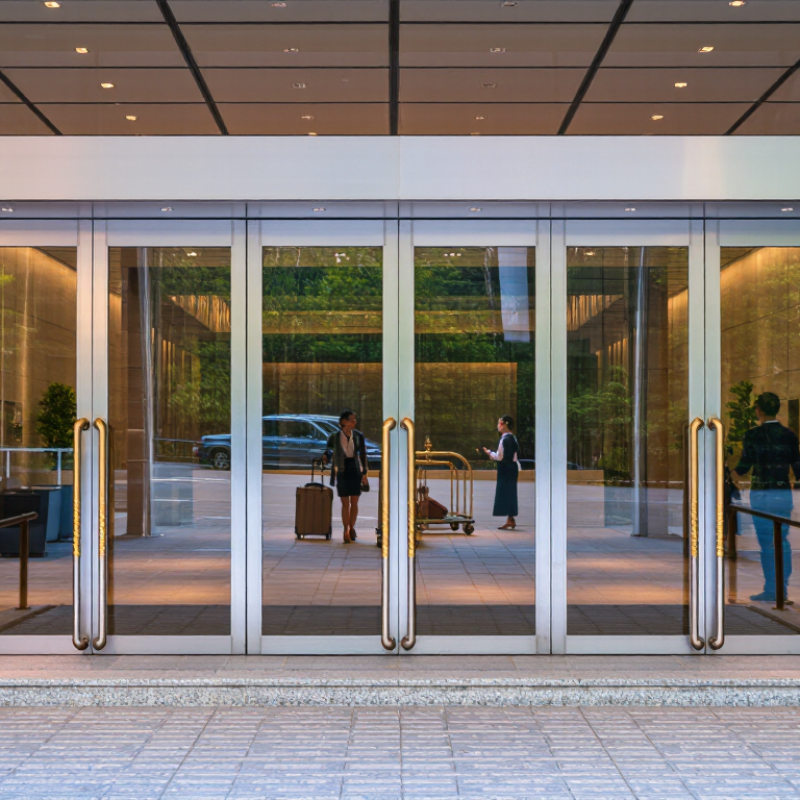
Identify the Hotel’s Traffic, Climate, and Accessibility Needs
Estimate entrance demand from arrival patterns, not room count alone. Track guest arrivals, departures, deliveries, and event peaks for several days. A footfall average can mislead: tour groups may arrive together, pushing luggage and strollers through one opening. Count the peaks. In cold, windy locations, inspect the doorway during bad weather; drafts, wet floors, and salt can expose weak seals or slippery thresholds. A vestibule may help limit air exchange, while durable finishes and weather seals can reduce maintenance. Still, a vestibule can feel cramped when queues form.
The World Health Organization’s 2022 global report estimates that 1.3 billion people, or about 16% of the population, experience significant disability.
Accessibility should shape the opening width, threshold, hardware, and operating method. That makes easy passage a core entrance requirement, not an occasional feature. In the United States, the 2010 ADA Standards specify a minimum 32-inch clear opening for accessible doors; requirements vary elsewhere. Check local standards and measure the usable opening with the door at 90 degrees. Consider wheelchair turning space, low-force operation, and controls reachable without stretching. Watch someone approach with a suitcase. Small obstacles become obvious. A perfect drawing does not always match a busy, wet entrance.
Compare Door Types, Materials, and Opening Mechanisms
A hotel’s main entrance must handle luggage, mobility devices, peak check-in traffic, and changing weather. Compare door types by their daily demands, not just appearance. Swing doors are simple and can seal well, but busy guests may find them awkward. Sliding doors keep traffic moving and need less clearance, though their sensors and tracks require regular attention. Revolving doors help limit drafts while allowing continuous passage. They can feel confusing to first-time visitors, especially when carrying bags.
Material choices affect durability, maintenance, and the welcome guests feel. Aluminum frames are relatively light and resist corrosion; steel offers strength but needs a suitable protective finish. Wood brings warmth, yet exposed surfaces may need more frequent care. Large glass panels make the lobby visible from outside, but fingerprints and glare quickly show. Ask suppliers for tested thermal and acoustic performance, not vague claims. Small details matter.
Opening mechanisms should match actual traffic. Automatic sliding doors suit steady, accessible flow; manual doors may be adequate at quieter entrances. Revolving systems can work well where drafts are a concern, but they need clear adjacent access for people who cannot use them. The 2024 Global Status Report for Buildings and Construction estimates that buildings account for 32% of global energy use and 34% of energy-related carbon emissions. That figure covers buildings broadly, not entrance doors alone. Still, it supports checking air leakage and operating performance. I would not choose by energy claims alone: entrance width, sensor response, maintenance access, and the rainy-day queue deserve equal attention.
Assess Security, Fire Safety, and Building-Code Requirements
A hotel main entrance door must protect guests without slowing safe evacuation. Start by checking local building and fire codes with the authority having jurisdiction and a qualified door professional. Requirements can vary by location, occupancy, and the wall assembly around the opening. A door’s fire rating alone does not prove the entire installation complies.
Look closely at the frame, glazing, hinges, latch, and closer as one system. Where a fire-rated assembly is required, confirm that each component is approved for that use and installed as specified. The door should close and latch reliably, even after frequent daily use. Details matter. A closer that slams can frustrate guests; one adjusted too slowly may not secure the opening as intended.
Security needs the same careful balance. Consider controlled access, sightlines from the front desk, and glazing that lets staff see approaching visitors. Any electronic locking or access-control feature must not obstruct required emergency egress. Test the door during routine inspections, including its closing action, latch, alarms, and hardware. Keep maintenance records, and ask a qualified professional to review unusual wear or changes to the entrance. It is tempting to choose the heaviest door available, but weight alone does not make an entrance safer.
Match the Entrance Door to the Hotel’s Architecture and Brand
A hotel’s main entrance should feel as though it belongs to the building, not like a decorative feature added at the end. A stone façade may suit a solid timber door, muted metalwork, and recessed glazing that preserves its traditional proportions. In a contemporary hotel, slender frames and larger glass panels can echo the clean lines outside while keeping the lobby visible from the street. Keep proportions in view. A door that looks impressive on a drawing may overwhelm a narrow frontage.
Brand character is expressed through details guests notice at close range: the pull handle’s shape, the warmth of the finish, and how easily the door opens. A quiet, understated hotel might use restrained hardware and natural textures; a more expressive interior may call for a distinctive handle or colored frame. Small choices matter. Check that these details work with the lobby’s lighting and materials, not just the exterior palette. A full-size sample or on-site mock-up can reveal mismatched tones and awkward reflections before installation. I have seen a carefully chosen finish look colder under evening lights than expected, so review samples in daytime and after dark. The best match feels intentional without making the entrance compete with the architecture.
How to Choose the Best Hotel Main Entrance Door
Match the entrance door to the hotel’s architecture and brand through materials, glazing, and detailing.
How to read this chart: Scores are illustrative design-fit ratings on a 1–5 planning scale, not survey results. Use them as a starting point: contemporary façades often pair well with clean metal lines and generous glazing, while classical or resort settings may call for warmer timber finishes and more traditional detailing.
Evaluate Installation, Maintenance, and Long-Term Costs
A hotel entrance door’s purchase price is only the visible part of its cost. Compare bids that include removal, frame preparation, weather seals, access controls, and after-hours labor. The U.S. Department of Energy’s Federal Energy Management Program life-cycle costing guidance recommends comparing acquisition, operation, maintenance, and replacement costs over time. Ask contractors to itemize these expenses. A low quote can hide costly site work.
Check performance evidence, not just the finish. ANSI/BHMA A156.4 sets a 2-million-cycle endurance test for Grade 1 door closers. That is a useful durability benchmark, not a guarantee of service life in a busy hotel. Count actual daily traffic, luggage-cart impacts, and wind exposure. Small details matter. A misaligned threshold can cause drafts, water entry, or repeated service calls.
Before choosing, price routine inspections and likely replacement parts. Ask whether seals, pivots, and closer arms are readily serviceable, and record expected labor hours. Track repair calls and energy complaints after installation; those records help reveal whether the entrance is costing more than planned. I would also leave room in the budget for adjustments during the first year. Real buildings are imperfect, and a door may need tuning after guests begin using it.