

How to Choose a Steel Frame Carport
A Steel Frame Carport can protect a vehicle from sun, rain, and falling debris, but the right model depends on more than price. Start with the space available. Measure the vehicle, allow room for doors to open, and check the height for roof racks or a raised tailgate. Small clearances matter. A carport that looks generous in a product photo may feel tight beside a fence or garage.
Compare frame dimensions, steel thickness, roof design, and protective finish using the manufacturer’s specifications. A powder-coated or galvanized finish may help resist corrosion, but performance depends on the product and its environment. Coastal air, heavy rainfall, and strong winds can place different demands on the structure. Check the stated load ratings and anchoring method, then confirm that the proposed base suits your site. Installation details deserve attention, too. A solid frame cannot compensate for poor anchoring.
This guide will help you weigh practical features against budget and long-term maintenance. It will also point out questions to ask suppliers, such as whether fixings are included and what tools or groundwork installation requires. Not every advertised feature is essential. And one detail is easy to miss: access around the car matters as much as the roof area. Compare carefully, and use verified specifications rather than assumptions when choosing a carport for your property.
Define Your Carport’s Purpose, Size, and Site Requirements
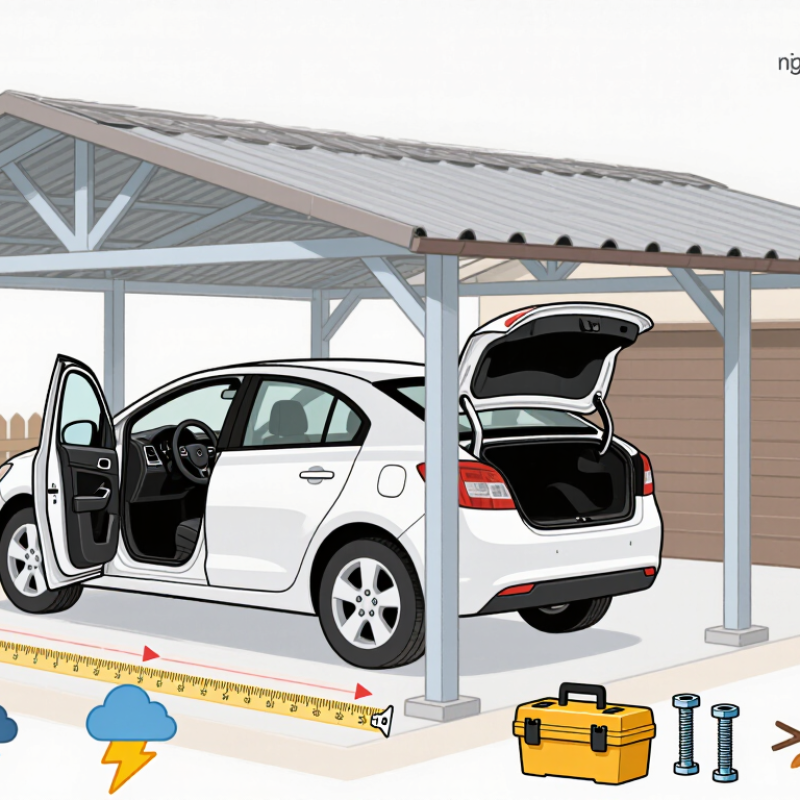
Start with use. A carport for one daily driver needs different clearances from a shelter for a truck, boat, or workshop storage. Measure the vehicle with doors open, mirrors extended, and any roof rack in place. Add room to walk around it and carry groceries without squeezing past a post. For two vehicles, check that both can enter and leave independently. A tight fit looks fine on paper, then becomes tiresome every morning.
Measure the site, not just the vehicle. Note the available width and depth, roof overhangs, fences, trees, and the route vehicles will take into the structure. Check the ground after rain: water pooling near a future post can complicate drainage and foundations. Sloped or uneven ground may also affect the frame layout. Mark the proposed corners with stakes, then walk the driving path. It is a simple check, but easy to skip.
Think about local weather and exposure before settling on dimensions. Wind, snow, and coastal conditions can influence the required frame and anchoring system; confirm suitable specifications with a qualified installer or engineer. Leave enough height for raised tailgates or a boat on a trailer, while considering nearby branches and overhead lines. Measurements are rarely perfect on the first pass. Recheck them, especially when the site has a slope or an awkward boundary.
Compare Steel Frame Materials, Gauges, and Protective Coatings
A steel-frame carport is only as dependable as its frame details. Common choices include galvanized steel, which has a zinc layer to slow rust, and painted or powder-coated steel, which relies on a surface finish for protection. Ask how the steel was treated, especially around cut edges and welded joints. Those spots can be more vulnerable when the coating is damaged. Look closely.
Gauge describes steel thickness, but numbering can be confusing: a lower gauge number generally means thicker steel. Compare the actual stated thickness and the manufacturer’s load information, not just the gauge label. Thicker members may feel more rigid, yet frame shape, spacing, bracing, and anchoring also affect performance. A post that barely flexes by hand is not proof of safe design. No gauge is magic.
Coatings matter most where moisture, road salt, or damp leaves collect. Inspect the underside of beams and the feet of the legs, where water may linger after rain. A galvanized frame can still corrode if its protective layer is deeply scratched; a painted frame may need touch-ups if its finish chips. Ask what maintenance is recommended and whether replacement parts are available. I would compare the written specifications before judging a frame by its shine. A glossy finish can hide little.
Choose a Roof Style and Weather-Resistance Features
A steel frame carport’s roof style affects more than appearance. Regular roofs use rounded panels that shed rain, while boxed-eave designs have a more finished look and straighter roof lines. Vertical panels run from ridge to eave, helping rain and light snow move downward rather than collect between ribs. They can be a practical choice where wet weather is common.
Weather resistance depends on the whole structure, not just the roof shape. Check the stated wind and snow-load ratings, and confirm they suit local conditions. Ask how the frame is anchored to the ground; strong panels cannot make up for weak anchoring. Look for a durable protective coating, sealed fasteners, and trim that directs water away from joints. Water finds gaps. Poor drainage can also stain nearby walls or leave puddles beneath the carport.
Consider the site before choosing. A low roof may fit beside a house, but it can limit clearance for taller vehicles. Nearby trees bring falling branches and leaf buildup, so easy-to-clean panels may matter more than a sleek profile. It is tempting to assume the heaviest roof is always best, but that can add cost without solving the site’s actual risks. Compare the installer’s specifications carefully, and ask what maintenance the finish needs over time. I would not treat a broad “all-weather” claim as enough detail.
Check Local Building Codes, Anchoring, and Installation Needs
How to Choose a Steel Frame Carport
Check local requirements before choosing a frame or ordering materials. Ask your building department whether the carport needs a permit, engineered drawings, or setbacks from property lines. Local rules may set minimum wind and snow loads, and the adopted code edition can differ between nearby towns. NOAA’s 2024 U.S. Billion-Dollar Weather and Climate Disasters summary records 403 costly events since 1980, with losses exceeding $2.9 trillion. That national figure is a useful reminder, not a substitute for site-specific design. Loads differ.
Ask which wind speed, exposure category, and snow load apply to your exact address. ASCE/SEI 7-22 sets design-load criteria for buildings and other structures, but your local official determines which requirements apply. Then check the anchoring plan against your soil and slab. A post bolted to thin concrete may not resist uplift; ground anchors also need suitable soil and installation depth. Do not assume the included anchors fit every site. One detail is easy to miss: locate buried utilities before driving anchors. Have the installer explain connection points, drainage, and required clearances, and get those details in writing. Photograph the finished anchors before they are covered. Small details matter.
How to Choose a Steel Frame Carport - Check Local Building Codes, Anchoring, and Installation Needs
| Decision factor | What to check | Practical guidance | Information to confirm |
|---|---|---|---|
| Local codes and permits | Permit requirements, zoning rules, setbacks, height limits, and required design loads. | Rules differ by jurisdiction and site. Ask the local building department before ordering or installing; do not assume a small or open-sided structure is exempt. | Written permit guidance, property-line setbacks, and applicable wind, snow, and seismic criteria. |
| Size and vehicle clearance | Vehicle length, width, height, door clearance, and room to walk around the vehicle. | Single-vehicle models are commonly around 12–18 ft wide and 20–30 ft long, but these are typical product dimensions, not code requirements. Measure the vehicle and allow extra working clearance. | Clear inside dimensions, post locations, roof overhang, and lowest roof clearance. |
| Frame and load capacity | Steel member specifications, connection details, corrosion protection, and documented design loads. | Choose a structure whose documented capacity meets the site-specific requirements. A heavier-looking frame alone does not establish that it is suitable for local conditions. | Engineering documents or load specifications for the exact configuration, roof style, and location. |
| Anchoring and foundation | Ground type, slab condition, anchor compatibility, and resistance to uplift and lateral movement. | Anchors for concrete, asphalt, or soil are not interchangeable. Use the anchoring method and installation details specified for the structure and approved for the site; a thin or cracked slab may not provide adequate support. | Required anchor type, number, spacing, embedment, concrete details, and any foundation design. |
| Site preparation and drainage | A level, stable installation area, surface drainage, overhead obstructions, and underground utilities. | Prepare a firm base and prevent water from pooling around supports. Contact the local utility-locating service before digging for posts or anchors. | Site measurements, drainage plan, utility markings, and any required grading or concrete work. |
| Installation and upkeep | Assembly requirements, safe access, tools, crew size, inspection access, and maintenance needs. | Check whether the structure can be assembled safely with available access and equipment. Follow the installation instructions, inspect connections periodically, and promptly address coating damage or corrosion. | Assembly instructions, component list, inspection requirements, and repair or maintenance guidance. |
Note: Dimensions shown are common examples only. Verify all code, permit, load, foundation, and anchoring requirements with the local authority and qualified professionals for the specific site.
Review Total Costs, Warranties, and Supplier Support
How to Choose a Steel Frame Carport
Review Total Costs, Warranties, and Supplier Support
A low frame price can look reassuring, but it rarely tells the whole story. Compare written quotes that list the structure, delivery, installation, anchoring, and site preparation separately. A gravel pad, uneven ground, or extra-long delivery route can add costs. Ask whether permits or engineering documents are included, if applicable. Small details matter.
Read the warranty before you decide. Check how long it covers the frame, roof panels, and protective coating; these may have different terms. Look for exclusions related to installation, maintenance, or weather damage. Also ask what proof is needed to make a claim. A long warranty sounds strong, but vague wording is hard to rely on. I would not compare warranty length alone.
Supplier support matters after the order arrives. Ask who handles missing parts, damaged panels, or installation questions, and how quickly they usually respond. Request care instructions and written specifications for wind or snow loads suited to your site. Keep the quote and warranty together. It is easy to overlook this step when comparing prices, and that can make later questions harder to resolve.
How to Choose a Steel Frame Carport: Total Cost, Warranty & Supplier Support
Illustrative 10-year cost comparison for three 12 × 20 ft Steel Carport configurations (USD).
These planning estimates are examples, not supplier quotes or a market survey. Actual costs depend on location, site preparation, permits, materials, and installation. Before choosing, compare warranty coverage and exclusions—not just its length—and confirm that the supplier provides clear specifications, installation guidance, replacement-part availability, and responsive after-sales support.