

How to Choose a Nylon Printing Machine?
Choosing a Nylon Printing Machine requires more than comparing prices, speed, or attractive product images. Nylon behaves differently from many common printing materials. It absorbs moisture, reacts to temperature changes, and may warp when cooling is uneven. A reliable decision begins with understanding your actual production needs.
In practical workshops, humidity control often matters as much as print resolution. A machine with a heated chamber can help maintain stable conditions around the build area. Drying systems are also valuable, especially when nylon filament has been stored in open air. Check the nozzle temperature range, bed heating performance, chamber design, and compatibility with reinforced nylon materials. Small details matter. A weak cooling system may create rough edges, while an inaccurate sensor can cause inconsistent layers.
Your expected parts should guide the machine choice. Functional prototypes may need strong layer bonding, while small production runs may prioritize repeatability and maintenance access. Review manufacturer specifications, independent testing, warranty terms, and user feedback from comparable applications. Do not rely on marketing claims alone. Ask whether replacement parts are available and whether technical support responds clearly.
No checklist is perfect.
I have seen buyers focus on maximum speed, then struggle with surface quality and failed prints. That mistake is understandable, but expensive. A careful evaluation should include sample printing, material testing, operating costs, and staff training. The best Nylon Printing Machine is not always the most powerful model. It is the one that delivers dependable results within your workspace, budget, and technical ability. Some compromises will remain. Recognizing them early leads to a more honest and practical investment.
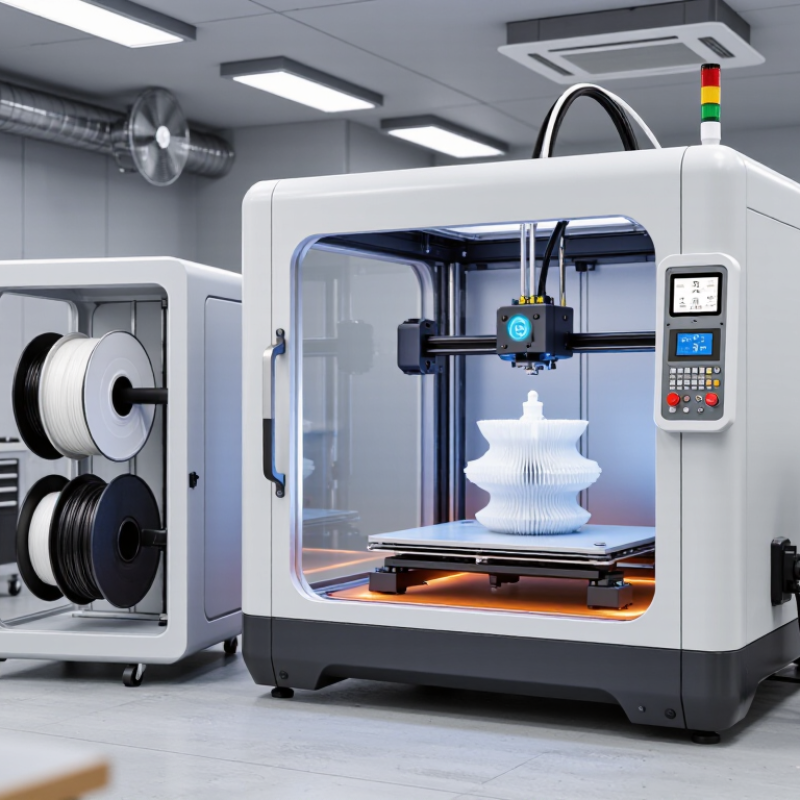
Nylon Printing Basics and Machine Types
How to Choose a Nylon Printing Machine?
Nylon is a strong, light engineering polymer, but it absorbs moisture quickly. That detail controls print quality. Wet filament can hiss, bubble, and produce brittle layers. Drying matters. In shop trials, I check spool moisture, chamber temperature, and cooling behavior before comparing speed. The Wohlers Report 2024 valued the global additive manufacturing industry at $20.035 billion in 2023, after 13.5% growth.
For nylon basics, start with the machine’s thermal design. Fused deposition modeling uses dried filament and a heated nozzle. It suits prototypes, fixtures, and smaller production runs. Selective laser sintering uses a heated powder bed and laser. It supports complex parts without support structures. Multi Jet Fusion spreads powder, then applies fusing and detailing agents. Its productivity can be attractive when many parts share one build. Powder handling, refresh ratios, and cooling time need measurement.
AM Research’s 2024 market outlook projected additive manufacturing revenues could reach about $40.8 billion by 2028. Use that growth carefully; a growing market does not guarantee a suitable machine. For occasional work, an enclosed filament system may be enough. For repeatable batches, consider powder systems with controlled temperature and documented maintenance. I still find advertised throughput misleading. Actual output includes drying, setup, cooling, depowdering, and inspection. A machine that prints fast may deliver slowly. Measure usable parts per week, not nozzle speed alone.
Define Your Material, Part, and Production Requirements
How to Choose a Nylon Printing Machine?
Define Your Material, Part, and Production Requirements
Choosing a nylon printing machine starts with the material, not the machine’s advertised speed. Nylon absorbs moisture quickly, so storage, drying, and handling conditions directly affect strength and surface quality. Moisture matters.
Identify the exact nylon type you need, such as reinforced nylon, flexible nylon, or standard engineering nylon. Then examine the part itself. A thin duct, a functional hinge, and a large enclosure require different thermal control, resolution, and build volume. Fit comes first. Measure wall thickness, tolerances, overhangs, and expected loads before comparing equipment specifications.
Production requirements shape the decision further. For occasional prototypes, a compact system may be practical. For repeated production, evaluate cycle time, chamber temperature stability, powder or filament management, cleaning effort, and operator training. Ask how many usable parts one build can deliver, not just how large the platform appears.
Request test samples using your actual geometry. Check holes with gauges, inspect warping, and record dimensional changes after cooling. A smooth sample can still hide weak layers or inconsistent shrinkage. Early estimates are often wrong when teams ignore post-processing time. Leave room for failed prints, maintenance, and material waste in your calculation. Reliable selection comes from measured results, clear process records, and requirements that match daily production.
Compare Print Technology, Build Volume, and Performance
Choosing a nylon printing machine starts with the process, not the advertised price. Selective laser sintering handles unsupported powder parts well and suits complex geometries. Powder-bed fusion can produce intricate components without extensive support structures. Fused filament fabrication may reduce equipment costs, but nylon needs a heated chamber and careful moisture control. I have seen strong designs fail because damp filament caused bubbles and weak layers. Small details matter.
A larger build volume helps only when your workflow can use it efficiently. Measure the usable chamber dimensions, not the machine’s outer footprint. A 300-millimeter cube may produce several small parts in one cycle. However, larger chambers often require longer heating times and more material. They can also increase the cost of one failed job. For prototypes, a smaller, stable chamber may outperform a larger, inconsistent system.
Compare layer thickness, dimensional accuracy, surface finish, throughput, and repeatability. Speed alone misleads. My early comparison relied too heavily on layer speed, and that was a mistake. The parts appeared efficient on paper but needed extra sanding and dimensional correction. Ask for test samples using the same nylon grade, moisture condition, and geometry. Check warping around corners, hole accuracy, and strength between layers. Review maintenance access, temperature monitoring, software control, and operator training requirements. Reliable performance should remain consistent across repeated builds, not only during a successful demonstration.
Evaluate Compatibility, Usability, and Maintenance Needs
How to Choose a Nylon Printing Machine?
Evaluate Compatibility, Usability, and Maintenance Needs
Nylon requires more control than common desktop materials. Check whether the machine supports the exact nylon grade you plan to use. The extruder should reach the manufacturer’s recommended temperature range. A heated build plate is essential. A heated chamber is also valuable for larger parts, because stable temperatures reduce warping and layer separation. Confirm that the nozzle resists abrasive additives if you print reinforced nylon. Small details matter.
Usability affects daily production. Look for an interface that shows nozzle temperature, chamber temperature, and filament status clearly. Automatic bed leveling can reduce setup time, but it is not always perfect. A rigid frame and controlled airflow help maintain consistent layers. Drying is critical. Nylon quickly absorbs moisture from the air. A built-in drying system or a separate sealed dryer can prevent bubbles, weak surfaces, and rough extrusion. Keep the spool dry.
Maintenance should be realistic for your workspace. Ask how easily you can clean the nozzle, replace filters, and access moving parts. Nylon dust and residue may collect around the drive gears. Inspect them regularly. I once blamed poor software settings for uneven walls, but damp filament caused the problem. That mistake was expensive and avoidable. Review service instructions, replacement-part availability, and electrical safety documentation before purchasing. A machine that prints beautifully but demands complicated cleaning may become a neglected tool.
How to Choose a Nylon Printing Machine? - Evaluate Compatibility, Usability, and Maintenance Needs
| Evaluation Dimension | Key Requirement | Basic Nylon Setup | Advanced Nylon Setup | Industrial Nylon Setup | Why It Matters |
|---|---|---|---|---|---|
| Material Compatibility | Supported nylon types | PA6, PA12, and unfilled nylon blends | PA6, PA12, nylon copolymers, and selected reinforced grades | PA6, PA12, high-temperature nylon, glass-fiber, and carbon-fiber-filled grades | Different nylon formulations require different thermal, mechanical, and abrasion-resistance capabilities. |
| Material Compatibility | Maximum nozzle temperature | At least 260 °C | Approximately 280–300 °C | Approximately 300–350 °C | Many nylon filaments print within roughly 250–300 °C, while modified high-temperature grades may require more. |
| Material Compatibility | Build plate temperature | 70–90 °C | 80–100 °C | 90–120 °C or higher, depending on the material | A heated build plate improves first-layer adhesion and reduces warping caused by thermal contraction. |
| Material Compatibility | Enclosure and chamber control | Enclosed build area; passive heat retention | Enclosed build area with controlled airflow and improved insulation | Actively heated chamber, commonly around 45–60 °C | A stable thermal environment helps reduce corner lift, layer separation, and dimensional variation. |
| Material Compatibility | Nozzle material | Hardened or wear-resistant nozzle recommended | Hardened steel or equivalent wear-resistant nozzle | Industrial wear-resistant nozzle system with easy replacement | Carbon-fiber- and glass-fiber-filled nylon can rapidly wear standard brass nozzles. |
| Material Compatibility | Filament drying capability | External filament dryer recommended | Dry box or heated storage connected to the printer | Integrated dryer with controlled temperature and humidity | Nylon is highly hygroscopic; absorbed moisture can cause bubbling, stringing, rough surfaces, and weak layers. |
| Usability | Recommended build volume | At least 200 × 200 × 200 mm | Approximately 250 × 250 × 250 mm or larger | Approximately 300 × 300 × 300 mm or larger | Choose a volume that accommodates the largest functional part while allowing clearance around the model. |
| Usability | Bed leveling | Manual leveling with assisted calibration | Automatic mesh leveling with manual adjustment options | Automated leveling, calibration routines, and compensation for thermal changes | Consistent first-layer height is especially important because nylon can be sensitive to adhesion conditions. |
| Usability | Print surface | Textured or coated removable build plate | Flexible removable plate with a nylon-compatible surface | Interchangeable engineered surface with controlled adhesion | Nylon adhesion varies by formulation; an appropriate surface reduces warping and makes part removal safer. |
| Usability | Motion and extrusion control | Stable extrusion with moderate print speeds | High-temperature direct-drive extrusion and reliable filament sensing | Closed-loop monitoring, consistent extrusion, and production-grade motion control | Nylon is flexible and can be difficult to feed through long or poorly guided filament paths. |
| Usability | Recommended starting print speed | 30–60 mm/s | 40–80 mm/s | 50–100 mm/s, subject to material and part geometry | Actual speed depends on nozzle size, layer height, cooling, thermal stability, and the specific nylon grade. |
| Usability | Monitoring and safety | Thermal runaway protection and basic temperature monitoring | Door sensor, power-loss recovery, remote monitoring, and smoke or temperature alerts | Multi-sensor monitoring, access control, event logging, and emergency shutdown | Long nylon prints benefit from continuous monitoring and safeguards against overheating or unattended failure. |
| Maintenance | Moisture management | Dry filament before printing; store in an airtight container with desiccant | Use a heated dry box during printing and reseal filament after use | Use controlled material storage with humidity monitoring and documented drying cycles | Drying temperature and time vary by nylon grade; follow the filament supplier’s instructions. |
| Maintenance | Nozzle inspection interval | Inspect after every 100–300 print hours when using unfilled nylon | Inspect approximately every 50–150 hours with reinforced nylon | Inspect according to measured wear, extrusion consistency, and production quality targets | A worn nozzle changes extrusion width and can reduce dimensional accuracy and layer consistency. |
| Maintenance | Routine cleaning | Clean the build plate and remove residue after each print | Clean the nozzle, drive gears, fans, and build area weekly or as needed | Use scheduled preventive maintenance covering filters, rails, belts, sensors, and thermal systems | Regular cleaning prevents adhesion problems, filament grinding, cooling faults, and contamination. |
| Maintenance | Consumable replacement access | Manual replacement of nozzle, tube, and build surface | Tool-assisted replacement with accessible wear components | Quick-change components with documented service procedures and spare-part availability | Easy access reduces downtime when abrasive materials or long production cycles accelerate wear. |
| Maintenance | Calibration requirements | First layer, extrusion flow, temperature, and retraction calibration | Automated calibration plus periodic flow, pressure, and temperature checks | Scheduled calibration with traceable measurements and quality records | Nylon processing is sensitive to moisture, temperature, cooling, and shrinkage, so calibration affects repeatability. |
| Selection Guidance | Best fit | Occasional prototypes and small functional parts | Frequent functional prototypes, fixtures, and low-volume production | Continuous production, large parts, reinforced nylon, and demanding dimensional requirements | Match the machine’s thermal control and maintenance capability to the intended workload. |
| Selection Guidance | Overall suitability score | 3.0 / 5 | 4.2 / 5 | 4.8 / 5 | Indicative score based on compatibility, ease of use, thermal stability, and maintenance capability. |
| Selection Guidance | Primary limitation | Limited chamber control and greater risk of warping on large parts | Higher operating cost and more frequent maintenance than basic systems | Higher purchase price, energy consumption, and operator training requirements | The most capable machine is not always the most economical choice for occasional or small-scale printing. |
Note: The temperature ranges, service intervals, and speed recommendations are general operating guidelines. Always confirm the exact requirements in the technical data sheet for the selected nylon filament and printing machine.
Assess Total Cost, Safety Features, and Supplier Support
How to Choose a Nylon Printing Machine?
A nylon printer costs more than its purchase invoice. Calculate electricity, drying, filters, maintenance, failed parts, and operator time. The Wohlers Report 2024 valued the global additive manufacturing industry at $20.035 billion in 2023, a 13.5% increase. That growth makes equipment choices more competitive, but not automatically safer or cheaper. I once compared only machine prices and underestimated drying energy and replacement filters. That was an expensive lesson. Ask suppliers for realistic annual operating costs, not optimistic showroom estimates.
Safety features deserve equal attention. Look for a sealed chamber, thermal runaway protection, door interlocks, temperature alarms, and clear maintenance procedures. Powder-based nylon systems need stronger dust control and carefully designed ventilation. ISO/ASTM 52931:2023 provides a useful framework for environmental, health, and safety considerations in additive manufacturing. Request emission-testing information, service records, and operator training details. A specification sheet can still hide practical weaknesses.
Tips: Compare five-year ownership costs. Test a sample part before signing. Confirm calibration intervals, spare-part availability, remote diagnostics, and response times in writing. Ask who supports the machine after installation. One overlooked question matters: can local technicians repair it? Supplier support should include training, troubleshooting, software updates, and documented safety guidance. If a supplier avoids failure-rate questions, pause. That hesitation may reveal more than a polished demonstration.