

What Are the Top 10 Laser Machine Manufacturers in China?
China has become a major source of industrial Laser Machines, serving metal fabrication, automotive, electronics, signage, and other sectors. Its manufacturers offer a wide range of equipment, from compact marking systems to high-power cutting and welding platforms. For buyers, the challenge is not simply finding a supplier. It is matching machine capability, production needs, budget, and after-sales support.
This guide introduces ten notable laser machine manufacturers in China and explains what buyers may want to examine when comparing them. Relevant factors include product range, stated technical specifications, industry experience, customization options, quality-control information, and service availability. A company’s catalog can show useful details, but it cannot confirm how a machine will perform in every workshop. That matters. Ask for application-specific demonstrations, written specifications, warranty terms, and clear information about installation and spare parts before making a decision.
The selection is intended as a practical starting point, not a universal ranking or an endorsement. Manufacturers differ in specialization, export experience, and support across regions; details can change over time. Some information may also be difficult to compare consistently. Buyers should verify current claims directly with each company and, where possible, speak with existing customers. With careful checks, this overview can help narrow the field and prepare more focused supplier discussions. A good fit depends on the work at hand.
What Laser Machine Manufacturers in China Produce
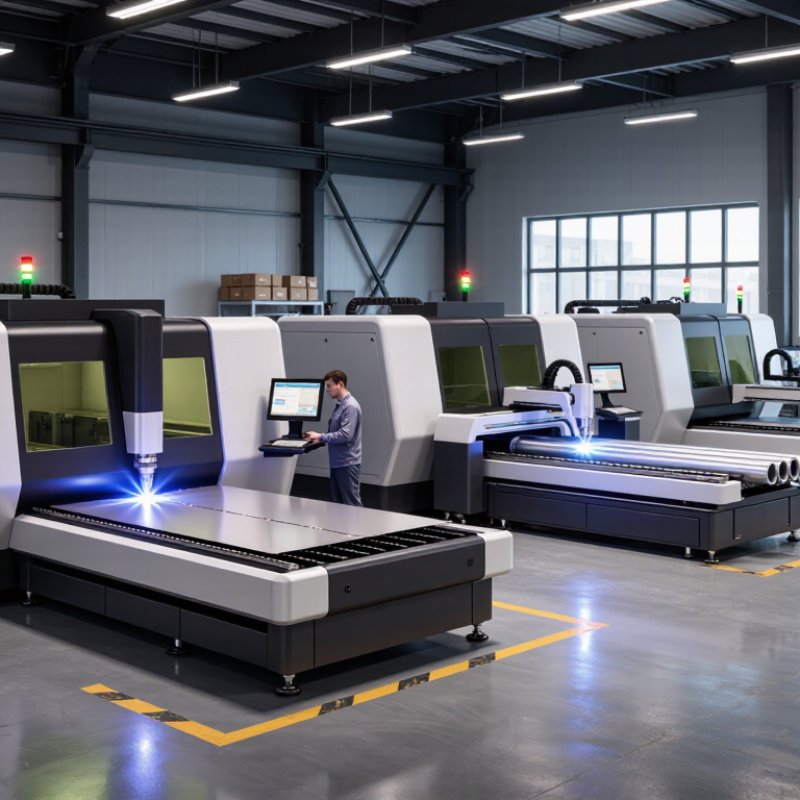
Chinese laser machine manufacturers produce more than sheet-metal cutters. Their range includes fiber-laser systems for cutting plate and tube, CO2 machines for wood and acrylic, and equipment for welding, marking, engraving, cleaning, and surface treatment. Some factories build compact workstations; others make enclosed CNC lines with automatic loading, extraction, chillers, and safety interlocks. The machine is only part of the process. Lens condition, assist-gas pressure, material thickness, and cutting speed can change edge quality noticeably.
Automation is expanding the context for these products. The International Federation of Robotics’ World Robotics 2024 report recorded 276,288 industrial robot installations in China in 2023, about 51% of global installations. That figure measures robot installations, not laser-machine production, but it helps explain demand for integrated cells. Not just cutters. Buyers should compare sample cuts, duty cycle, service response, and replacement-part availability against their actual materials. A thick stainless-steel plate and a thin aluminum tube need different setups. Product categories also overlap, and published specifications may not show performance under continuous production. Details matter. Manufacturers’ offerings vary, so a factory visit or witnessed test can reveal gaps that a brochure cannot.
What Laser Machine Manufacturers in China Produce
Common laser machine types use different laser sources. The chart compares typical source wavelengths; actual specifications vary by machine and configuration.
Typical examples: UV (355 nm), green (532 nm), fiber (about 1,064 nm), and COâ‚‚ (about 10,600 nm). This is a technology comparison, not a manufacturer ranking.
How to Evaluate China’s Laser Machine Manufacturers
China’s laser-machine market offers many configurations, but a low quoted price says little about performance. Grand View Research estimated the global laser-cutting-machine market at USD 5.7 billion in 2023, with growth projected through 2030. This signals expanding demand, not guaranteed supplier quality. The International Federation of Robotics reported that China installed 276,288 industrial robots in 2023. That figure reflects a strong automation ecosystem, but it does not prove a particular machine’s precision or reliability.
Evaluate suppliers using the same test conditions. Ask them to cut your material thickness and grade, then inspect edge quality, dimensional tolerance, and cycle time. Request a written specification for laser power, positioning accuracy, and expected uptime. Check whether the warranty covers key components, and ask how quickly technicians can respond. A factory visit can reveal practical details: spare parts on shelves, calibration records, and operators running real jobs. One limitation: a polished demonstration may not show performance after months of continuous use.
Tips: Send identical sample files to shortlisted suppliers. Compare measured results, not promises. Confirm software support, training, and replacement-part lead times in writing. Numbers need context. A cheaper machine may still cost more when downtime, maintenance, and rejected parts are included.
Profiles of 10 Leading Chinese Laser Machine Manufacturers
Chinese laser-machine manufacturers serve a wide range of factory needs, from basic cutting to automated production. One profile centers on large-format fiber cutters for sheet metal, where bed stability and cutting-head protection matter. Another specializes in tube cutting, with chuck design affecting accuracy on long sections. A third focuses on compact machines for workshops with limited floor space. A fourth builds CO2 systems for nonmetal materials, where extraction and lens care deserve close attention.
Other profiles include a maker of laser marking equipment for traceable part identification, and one focused on precision processing of small components. A welding-equipment producer may prioritize handpiece comfort and consistent power delivery. Automation-focused manufacturers integrate loading, unloading, and material handling around the laser. Details matter. Their systems can reduce repeated manual steps, but add setup and maintenance demands. A further profile emphasizes configurable machines for varied production runs; another gives particular weight to installation and after-sales support.
These profiles are not interchangeable. Buyers should compare working area, material range, duty cycle, and demonstrated cut quality on their own samples. Ask for clear service terms and practical training, not just a polished specification sheet. Not every catalog is equally useful. Published performance figures may depend on material thickness, settings, and operating conditions, so they need context. Even a strong machine can disappoint when the application is poorly matched.
How the Manufacturers Compare Across Key Factors
Comparing Chinese laser machine manufacturers requires more than ranking quoted power or purchase price. A fiber cutter rated for thick plate, for example, may not deliver clean edges at a workshop’s usual speed. Ask for sample cuts using your own material, thickness, and file type. Inspect the kerf, corner quality, and consistency across repeated passes. Small details reveal real capability.
Build quality also appears in less visible parts: motion components, guarding, extraction connections, and the control interface. Request specifications for the laser source, cutting head, chiller, and supported software, then confirm what is included in writing. Service matters just as much. Compare response hours, spare-part availability, remote diagnostics, and technician training. A low initial quote can become expensive if downtime lasts days.
Warranty language deserves careful reading. Check exclusions, travel costs, consumables, and coverage for components supplied by subcontractors. Ask for installation requirements and a maintenance schedule, not just a brochure. Then compare total ownership cost against expected shifts, energy use, and operator skill. It is not perfectly measurable. Supplier claims can be optimistic, and buyers may overlook their own workflow. Visit a working site if possible, and speak with an operator who uses the machine daily.
What Are the Top 10 Laser Machine Manufacturers in China? - How the Manufacturers Compare Across Key Factors
A fact-based manufacturer ranking requires current, model-specific source data. This comparison framework avoids unsupported company-level scores and shows what to verify when comparing suppliers.
| Comparison Factor | What to Compare | Why It Matters | Evidence to Request |
|---|---|---|---|
| 1. Machine category | Fiber laser cutting, CO₂ laser cutting, laser marking, welding, or a combination. | Different laser processes are suited to different materials and production tasks. | Model datasheets and sample tests using the buyer’s material and application. |
| 2. Laser source and rated power | Source type, rated output, service terms, and compatibility with the machine configuration. | Power alone does not determine cutting results; material, thickness, optics, gas, and process settings also matter. | Written configuration list, source documentation, and application-specific test results. |
| 3. Working area and format | Usable processing area, supported sheet or part dimensions, and loading arrangement. | The work envelope must fit the buyer’s parts, material formats, and factory layout. | Dimensioned machine drawings and confirmation of usable—not just nominal—working dimensions. |
| 4. Material and thickness capability | Supported material types and tested thicknesses for the exact machine configuration. | Maximum-thickness claims can vary with material grade, cut quality requirements, assist gas, and operating conditions. | Cut samples or test reports that state material, thickness, gas, speed, and edge-quality criteria. |
| 5. Accuracy and repeatability | Positioning accuracy, repeatability, and the measurement conditions specified by the supplier. | Published figures are meaningful only when the test method and operating conditions are clear. | Technical specifications, acceptance-test procedure, and inspection records for the delivered machine. |
| 6. Automation and productivity | Loading and unloading options, pallet changer, material handling, and software workflow. | Automation can reduce manual handling, but its value depends on production mix and utilization. | Equipment list, cycle-time assumptions, and a production demonstration using representative jobs. |
| 7. Safety and compliance | Enclosure, interlocks, extraction provisions, electrical requirements, and destination-market compliance. | Applicable requirements depend on the machine configuration and the country where it will be installed. | Relevant declarations, certificates, risk documentation, and a written list of included safety features. |
| 8. Warranty and after-sales service | Coverage period, exclusions, response channels, spare-parts availability, and service locations. | Warranty scope and service arrangements are supplier- and contract-specific. | The written warranty, service-level commitments, escalation process, and parts quotation. |
| 9. Software and integration | Included control and nesting software, file compatibility, licenses, updates, and factory-system interfaces. | Software capabilities and licensing can differ by model, package, and market. | Software version, license terms, supported file formats, and a workflow demonstration. |
| 10. Total cost of ownership | Machine price, installation, training, consumables, energy, maintenance, shipping, and duties. | Purchase price alone does not represent the full cost over the machine’s operating life. | An itemized quotation and clearly stated assumptions for recurring and one-time costs. |
How to Choose a Chinese Laser Machine Manufacturer
Choosing a Chinese laser machine manufacturer starts with your actual workpiece, not the headline wattage. Ask for a cutting or engraving sample using the same material, thickness, and finish you expect in production. Check edge color, kerf width, repeatability, and setup time; a polished showroom sample proves little by itself. Keep the test file and settings. They make later comparisons fairer.
Review the machine configuration in writing: laser source, motion system, control software, extraction, cooling, and included safety features. Request a parts list, warranty terms, response hours, and prices for wear items such as lenses and nozzles. Ask who handles commissioning and whether remote support is available in your time zone. If possible, inspect a running machine and speak with a recent buyer in a similar industry. Verify certifications against the exact model and destination market, rather than relying on a general brochure. Test it yourself.
A low quote may omit installation, training, or shipping protection. Compare total delivered cost and realistic lead time, not just machine price. Some details will remain uncertain until the machine runs in your shop; acknowledge that, and agree on acceptance criteria before payment. Clear technical answers matter, but they still deserve checking.