

What Are the Top 12 Fiber Optic Cable Types in 2026?
Reliable connectivity depends on more than bandwidth. The cable’s construction matters too. In 2024, the International Telecommunication Union reported that 5.5 billion people were online, about 68% of the world’s population. That scale puts pressure on networks to carry more traffic while handling varied routes, environments, and installation demands.
The 12 Fiber Optic Cable types in this guide are not interchangeable. A tight-buffered cable may suit an indoor run; armored cable can add physical protection where routes face greater exposure. Single-mode and multimode fibers also serve different distance and equipment needs. Small details matter: a bend behind a rack, a damp conduit, or a connector exposed to dust can change installation choices. Charles K. Kao, a pioneer of fiber-optic communications, helped establish the case for low-loss glass fiber. His 1966 paper with George Hockham argued that sufficiently pure glass could carry light over practical communication distances.
Industry reports offer useful context, not a universal buying rule. ITU figures describe rising connectivity needs, while deployment reports from the Fiber Broadband Association track continued fiber-network expansion. Neither report selects a cable for every site. That judgment still depends on distance, surroundings, bend limits, and termination plans. Some specifications look clear on paper. Field conditions are messier. This comparison introduces twelve common cable types and explains where each may fit, while noting the trade-offs readers should verify before choosing.
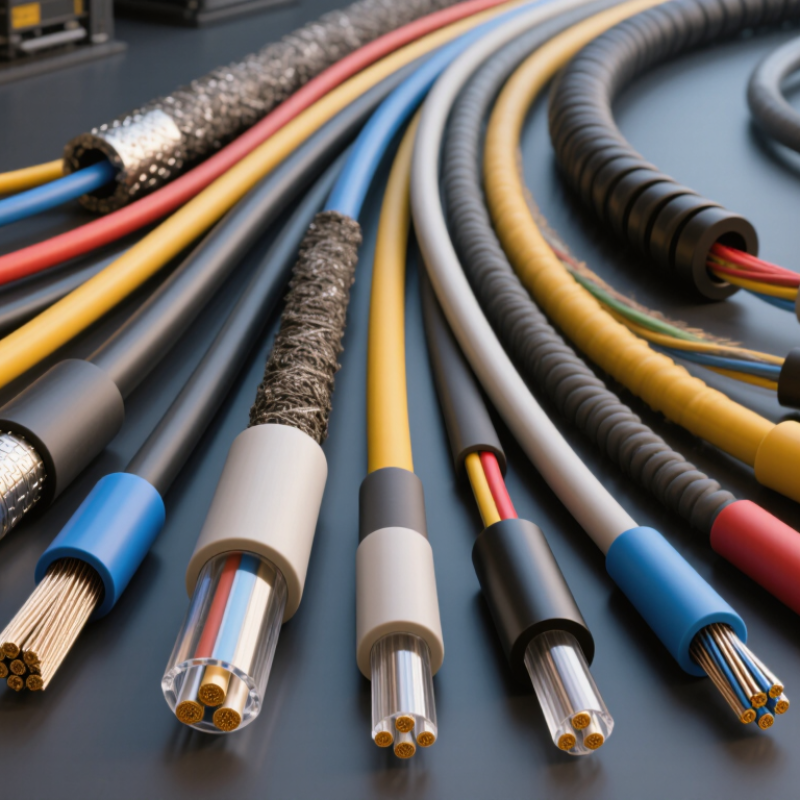
How Fiber-Optic Cables Are Classified by Mode, Construction, and Deployment
Fiber-optic cable types are best understood through three questions: how light travels, how the cable is built, and where it will be installed. Single-mode fiber carries light along one main path and is commonly used for long-distance links. Multimode fiber carries several light paths and often serves shorter connections within buildings. OM1, OM2, OM3, OM4, and OM5 are multimode grades with different performance capabilities. Check the equipment and link requirements.
Construction adds another layer. Simplex cable has one fiber; duplex cable has two, often used for two-way connections. Ribbon cable groups many fibers in a flat arrangement, while tight-buffered designs protect fibers for indoor handling. Loose-tube construction leaves room around fibers and is common outdoors. Armoring adds crush and rodent protection, but also weight and handling trade-offs. These labels overlap.
Deployment conditions matter just as much. Indoor cables may need fire-rated jackets, while outdoor designs must withstand moisture and temperature changes. Aerial cable hangs between supports; direct-burial cable is designed for underground placement. A cable described only as “single-mode” is not fully specified. Include its construction, environment, fiber count, and connector requirements. A neat category chart can help, but real installations are messier: pathway space, bend limits, and future capacity can change the choice.
What Are the Top 12 Fiber Optic Cable Types in 2026?
A classification snapshot by mode, construction, and deployment
The chart counts 12 representative types: OS2 and OM1–OM5 by mode; ribbon, loose-tube, and tight-buffered by construction; and indoor-rated, aerial, and submarine by deployment. These are counts of examples in this chart, not market-share figures. Classification dimensions can overlap in real cable designs.
Single-Mode OS2 and Multimode OM1–OM5: Six Types Defined by Standards
The six standardized families divide into one single-mode type and five multimode types. OS2 uses a small core, typically around 9 micrometers, to carry light over long distances with low attenuation. It suits campus links, service-provider routes, and connections between buildings. The glass is not magic; connector cleanliness and bend radius still matter.
OM1 has a 62.5-micrometer core, while OM2, OM3, OM4, and OM5 use 50-micrometer cores. OM1 and OM2 are common in older installations, but their reach at higher data rates is limited. OM3 and OM4 are laser-optimized for short-wavelength systems, often using 850-nanometer VCSELs. OM4 generally supports longer link distances than OM3 at the same rate. OM5 adds support for shortwave wavelength-division multiplexing across roughly 850 to 953 nanometers. That matters. Still, the category alone never tells the whole story: achievable distance depends on transceivers, data rate, connectors, and the complete link budget.
Check the relevant standards and equipment specifications before choosing cable. A label can simplify comparison, but it cannot replace a measured design.
OM4 and OM5 Bandwidth Benchmarks: 4,700 MHz·km at 850 nm; OM5 Adds 953 nm
OM4 and OM5 both specify a minimum effective modal bandwidth of 4,700 MHz·km at 850 nm. That figure, defined in industry specifications including IEC 60793-2-10 and TIA-492AAAE, helps describe how much data a multimode fiber can carry over distance. It is not a guaranteed network speed. OM5 keeps the 850 nm benchmark and adds a specified operating window through 953 nm; its minimum bandwidth at 953 nm is 2,470 MHz·km. The extra wavelength range can support shortwave wavelength-division multiplexing, which sends multiple channels through one fiber pair.
Tips: Check the transceiver’s wavelength and reach requirements before choosing OM5. A wider wavelength range does not automatically improve every link. For example, a 100-meter data-center connection may benefit from parallel optics instead. Measure the installed path, including patch panels and bends. Small details matter.
In practice, OM4 remains a capable choice for many 850 nm links, while OM5 offers more wavelength flexibility. I would not select either cable by headline bandwidth alone. Connector cleanliness, link length, and equipment compatibility can change the result. The standards provide useful benchmarks, but real installations still need testing. That part is easy to underestimate.
What Are the Top 12 Fiber Optic Cable Types in 2026? - OM4 and OM5 Bandwidth Benchmarks: 4,700 MHz·km at 850 nm; OM5 Adds 953 nm
| Type or category | Fiber / construction | Key optical benchmark | Typical wavelengths | Common use |
|---|---|---|---|---|
| OS1 | Single-mode cabling category; typically used for indoor cabling | No multimode EMB rating; attenuation limits depend on the applicable cabling standard | Commonly 1310 and 1550 nm | Indoor backbones and building links |
| OS2 | Low-water-peak single-mode cabling category; commonly deployed in outdoor loose-tube cables | No multimode EMB rating; designed for low-loss single-mode transmission over long links | Commonly 1310 and 1550 nm | Campus, metro, and outside-plant networks |
| OM1 | 62.5/125 µm multimode fiber | Minimum EMB: 200 MHz·km at 850 nm | 850 and 1300 nm | Legacy premises networks and short links |
| OM2 | 50/125 µm multimode fiber | Minimum EMB: 500 MHz·km at 850 nm | 850 and 1300 nm | Short-reach links in older premises installations |
| OM3 | 50/125 µm laser-optimized multimode fiber | Minimum EMB: 2,000 MHz·km at 850 nm | 850 nm; also specified for 1300 nm operation | Short-reach data-center and building links |
| OM4 | 50/125 µm laser-optimized multimode fiber | Minimum EMB: 4,700 MHz·km at 850 nm | 850 nm; also specified for 1300 nm operation | Higher-bandwidth short-reach data-center links |
| OM5 | 50/125 µm wideband multimode fiber | Minimum EMB: 4,700 MHz·km at 850 nm and 2,470 MHz·km at 953 nm | Wideband range of 850–953 nm | Short-reach links using multiple wavelengths over multimode fiber |
| G.652.D | Standard single-mode fiber; nominal 9/125 µm class | Zero-dispersion wavelength is in the 1310 nm region; low water-peak characteristic | Broadband use including 1310 and 1550 nm | General-purpose access, metro, and long-distance networks |
| G.657.A1 | Bend-insensitive single-mode fiber; compatible with G.652.D requirements | Specified for tighter bends than conventional G.652 fiber; 10 mm minimum bend-radius class | Commonly 1310, 1490, and 1550 nm | Access networks, building entry, and tight routing paths |
| G.657.A2 | More bend-tolerant single-mode fiber; compatible with G.652.D requirements | Specified for tighter bends than G.657.A1; 7.5 mm minimum bend-radius class | Commonly 1310, 1490, and 1550 nm | High-density access cabling and space-constrained enclosures |
| G.654.E | Low-loss, large-effective-area single-mode fiber | Large effective area, typically at least 110 µm² for the E category, supporting long-haul transmission | Optimized primarily for the 1550 nm region | Long-haul terrestrial and submarine systems |
| G.655 | Non-zero dispersion-shifted single-mode fiber | Maintains controlled, non-zero chromatic dispersion to help limit nonlinear effects in dense wavelength-division systems | Designed for the 1550 nm region, including the C-band | Long-haul and wavelength-division multiplexed networks |
Note: OM bandwidth figures are effective modal bandwidth (EMB) values. OS1 and OS2 are cabling categories, while G.652, G.654, G.655, and G.657 identify single-mode fiber recommendations; their specifications are not directly comparable to multimode EMB.
Construction Types: Tight-Buffered, Loose-Tube, Ribbon, and Armored Cables
What Are the Top 12 Fiber Optic Cable Types in 2026?
Construction Types: Tight-Buffered, Loose-Tube, Ribbon, and Armored Cables
Cable construction determines how fibers handle moisture, pulling forces, tight bends, and field repairs. The Fiber Optic Association’s reference guide distinguishes common 900-micrometer tight-buffered fibers from 250-micrometer fibers used in loose-tube designs. That small measurement changes installation needs. Tight-buffered cables protect each fiber with a firm coating, making them practical for indoor runs, patching, and termination. Loose-tube cables place fibers inside protective tubes, often with water-blocking materials. They suit outdoor routes where temperature swings and moisture are real concerns. Still, “outdoor” alone is not a complete specification; route conditions matter.
Ribbon cables arrange fibers in flat, bonded groups, which can speed mass fusion splicing when many fibers share a route. They are useful in high-count backbone links, but the ribbon format may be less convenient in cramped closures. Armored cables add a protective layer against crushing or rodents, especially in exposed pathways. That protection brings extra weight and can complicate handling. Choose armor only when the route calls for it.
The FOA’s installation guidance is useful, but field conditions can defeat a tidy specification. A tight-buffered cable may be easier to terminate indoors, yet it is not automatically right for every riser. A loose-tube cable may survive an outdoor pull, but bend limits still matter. Check the cable’s datasheet, route, splice plan, and installation method before choosing.
Deployment Types: Aerial and Submarine Cables, Compared by Installation Needs
Aerial and submarine cables are defined less by their glass fibers than by the conditions around installation. Aerial routes run on poles or towers, where crews can inspect spans and access many faults without specialized marine equipment. Self-supporting ADSS cables carry their own tension; other designs attach to a messenger wire. Wind, ice, tree growth, and pole loading all affect the choice. A cable that looks light can add meaningful load across a long span. That is easy to miss.
Submarine cables need careful route surveys, purpose-built installation vessels, and coordination at coastal landing points. Crews pay close attention to seabed type, water depth, and shipping activity. Near shore, stronger armoring or burial may help protect the cable from anchors and fishing gear. In deeper water, lighter constructions can be suitable, depending on route conditions. Repairs can take longer because vessels must locate, retrieve, and resplice the damaged section. No quick fix.
The neat division is imperfect: aerial routes can cross rivers, and submarine links often include buried land sections. Engineers typically compare access, environmental exposure, repair time, and installation cost before selecting a cable construction. For aerial spans, checking existing pole capacity matters as much as the cable specification. For marine routes, survey data should guide protection choices; heavier armoring everywhere may add cost without solving the actual risk. A desktop map alone is rarely enough.