

top of page

Top Cylinder Piston Rod Manufacturers for Global Buyers

A Cylinder Piston Rod can look simple on a drawing: a polished shaft, a threaded end, and a carefully controlled diameter. In service, however, small flaws matter. Scoring, corrosion, or poor chrome coverage can damage seals and shorten cylinder life. Global buyers therefore need more than a low unit price. They need evidence of material consistency, machining control, surface finish, and dependable delivery.

The market context supports careful supplier selection. Grand View Research’s Hydraulic Cylinder Market report identifies construction, agriculture, material handling, and industrial machinery as important application areas. These sectors place different demands on rod strength, coating, dimensions, and production volume. Buyers should compare manufacturers against their own operating conditions, then request inspection records and clear tolerances. A polished sample is not enough.

There is a source limitation worth stating. No verified quotation from a named Cylinder Piston Rod specialist was supplied, so assigning one would risk inventing evidence. Anthony Esposito’s Fluid Power with Applications is a recognized technical reference, but a direct quotation should be checked against the original text before publication. That caution matters. This guide will assess manufacturers through practical criteria: materials, surface treatment, quality documentation, customization, and export support. It will also acknowledge a common sourcing weakness: published specifications do not always reveal how consistently a factory meets them.
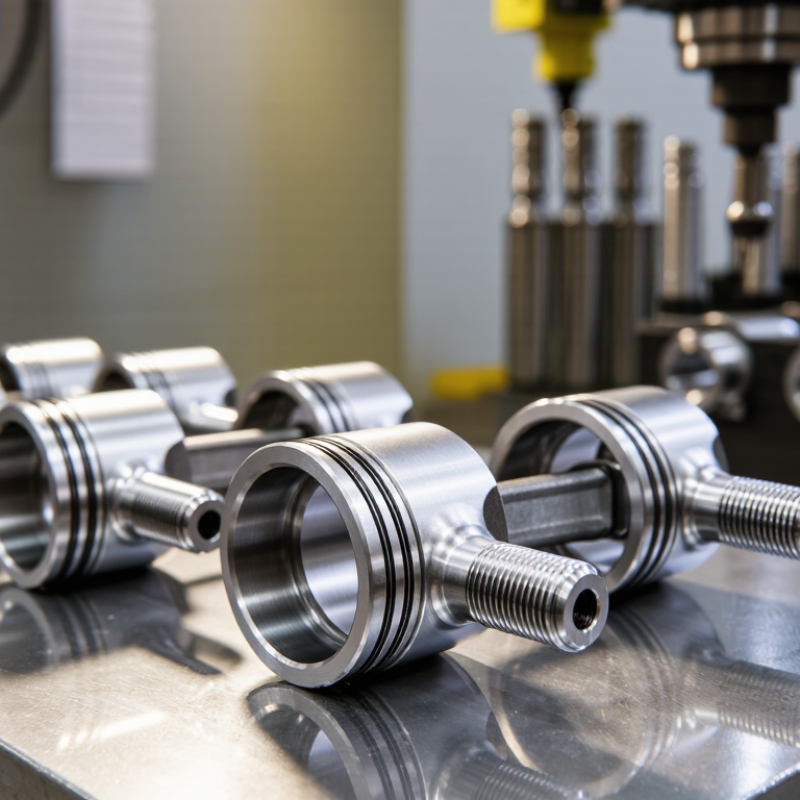
Top Cylinder Piston Rod Manufacturers for Global Buyers

Understanding Hydraulic Cylinder Piston Rods and Their Applications

A hydraulic cylinder piston rod transfers force from the piston to a moving load. Its polished surface passes through the cylinder head seal on every stroke. Scratches, corrosion, or a slightly bent rod can damage seals and cause leakage. The risk is especially clear on excavators working in grit, farm machinery exposed to moisture, and forklifts cycling through dusty warehouses. The rod is not just a steel shaft.

Rod dimensions and operating pressure must match the cylinder design. ISO 6020-2 provides dimensional guidance for selected medium-series cylinders, but real equipment may use other specifications. Buyers should check rod diameter, stroke, surface finish, coating, and side-load conditions. A detail often missed: side loading can shorten service life even when the rated pressure is not exceeded.

Grand View Research estimated the global hydraulic-cylinder market at USD 14.58 billion in 2023 and forecast 5.3% annual growth from 2024 to 2030. That figure covers complete cylinders, not piston rods alone; it signals application demand, not rod sales. Construction, agriculture, material handling, and industrial presses all rely on linear hydraulic motion. Reports differ in market scope, so the number is useful context, not a purchasing guarantee. A rod that looks flawless may still fail early if its coating or alignment does not suit the working environment.

How Piston Rods Are Manufactured and Tested

Cylinder piston rods are commonly made from alloy-steel bar, then cut, turned, and ground to the drawing’s diameter. Heat treatment can strengthen the surface while preserving a tougher core. A protective coating may be applied where corrosion resistance is required. The process is not identical for every duty; material, coating, and finish depend on load, seals, and operating environment.

Testing starts with measurable checks. Inspect diameter, straightness, and surface texture at several points, not just at the rod ends. ISO 6508-1 specifies the Rockwell hardness test, while ISO 21920-2 defines surface-profile parameters. For corrosion evaluation, ISO 9227 describes salt-spray testing; exposure hours should not be treated as a direct prediction of service life. A polished rod can still fail. A single test cannot tell the whole story.

Tips: Match the surface finish to the seal specification, and record the actual readings against the purchase drawing. After assembly, monitor hydraulic-fluid cleanliness using the particle-count coding in ISO 4406:2021. Small scratches matter. Keep test records tied to each production batch so defects can be traced and reviewed.

How Piston Rods Are Manufactured and Tested

Typical hardness ranges for an induction-hardened piston rod

Piston rods are commonly machined, induction hardened, ground, and finished with a protective coating. Hardness testing checks that the hardened surface meets its target while the core retains suitable toughness. The ranges shown are indicative; actual requirements vary by steel grade and product specification.

Leading Piston Rod Manufacturers Serving Global Markets

Leading piston rod manufacturers serving global markets must balance precision, durability, and dependable delivery. A rod may look simple, yet its surface finish and straightness affect seal wear and cylinder performance. Buyers should ask about material grades, heat treatment, coating thickness, and inspection records. Small defects matter.

Experienced suppliers can explain how they control key dimensions from machining through final inspection. Ask for sample measurement reports and clarify how tolerances are checked. For example, a polished rod should arrive without visible scoring, burrs, or inconsistent coating near its ends. Clear packaging and traceable batch details also help protect parts during long-distance shipping.

Global orders bring practical challenges. Lead times, communication, and replacement procedures deserve attention alongside price. A polished catalog is not enough. Request a sample or technical review before approving a large order, especially when the rod must match an existing cylinder. No manufacturer is perfect, and a supplier’s response to a quality concern can reveal as much as its advertised capabilities. Buyers should document agreed specifications and confirm them before production begins.

How to Evaluate Manufacturers for Quality and Reliability

For global buyers, a piston rod’s finish is more than a polished surface. Check the steel grade, heat-treatment records, coating thickness, straightness, and surface roughness against your drawing. Ask for traceable material certificates and inspection results from actual production batches, not only a sample made for a sales visit. A micrometer reading at several points can reveal uneven coating. A roughness trace can show defects hidden by shine.

ISO’s 2022 Survey recorded more than 1.26 million valid ISO 9001 certificates across 189 countries.

This signals broad use of quality-management systems, but a certificate alone does not prove rod performance. Not enough. Ask how the maker controls process changes, rejects, and corrective actions. For corrosion protection, request test results using a stated method, such as ISO 9227, with agreed acceptance criteria. For reliability, review fatigue or load-test data that matches your pressure, stroke, and duty cycle. Compare lead-time history and packaging controls too; rods can arrive scratched or bent. One honest caveat: test conditions rarely mirror every field installation, so buyers should validate a production sample in their own assembly before committing to large volumes.

Key Considerations for International Sourcing and Supply

International sourcing of cylinder piston rods starts with a drawing that leaves little room for guesswork. Specify material grade, rod diameter, straightness, surface hardness, coating thickness, and allowable runout. Ask suppliers for inspection records tied to each production lot, not only a general quality certificate. A polished surface can still hide inconsistent hardness beneath it.

Logistics deserves equal attention. UNCTAD’s Review of Maritime Transport 2024 reports that ships carry over 80% of world trade by volume, making port delays and handling conditions relevant to rod deliveries. Confirm packaging prevents corrosion and impact damage; exposed threads and long, unsupported rods are vulnerable during transit. The World Bank’s 2023 Logistics Performance Index compares 139 economies across areas including customs, infrastructure, tracking, and timeliness. Use those measures as context, not as a substitute for checking a specific route.

Plan samples and acceptance criteria before placing a volume order. Request dimensional reports, material traceability, and coating test results, then verify a sample independently when the application is critical. Keep a buffer for customs and transport variability. It may feel excessive. Yet a buffer cannot fix unclear specifications, and even experienced buyers sometimes discover that their inspection plan missed a detail.

Top Cylinder Piston Rod Manufacturers for Global Buyers - Key Considerations for International Sourcing and Supply
Sourcing Dimension What to Specify or Expect How Buyers Can Verify
Material and grade Specify the steel grade and applicable standard on the drawing or purchase specification. Common choices include medium-carbon steel and alloy steel; suitability depends on load, fatigue, corrosion exposure, and heat treatment. Request a material test certificate traceable to the supplied batch, and confirm grade, heat number, and any required mechanical properties.
Rod dimensions and tolerances Define diameter, overall length, thread details, shoulders, grooves, and dimensional tolerances on an approved drawing. Do not assume that nominal dimensions alone define interchangeability. Review the supplier’s inspection plan and dimensional report; agree on measurement methods and acceptance limits before production.
Surface finish and coating State the required surface roughness, coating type, and coating thickness on the drawing. Hard chrome plating is commonly used on hydraulic cylinder rods, while alternative coatings may be selected for specific corrosion or wear requirements. Ask for coating inspection records, thickness readings, and surface-finish results against the agreed specification.
Straightness and runout Set straightness and runout limits according to rod length, diameter, operating conditions, and cylinder design; these limits should be agreed rather than assumed to be universal. Request the inspection method, support arrangement, measurement locations, and recorded results for the finished rod.
Corrosion protection Choose the rod material and surface protection for the actual environment, including moisture, salt exposure, chemicals, and storage duration. Corrosion performance depends on the complete coating system and application. Define any required corrosion test method and acceptance criteria in the contract; request test evidence where applicable.
Manufacturing and quality controls Confirm process controls for machining, heat treatment, grinding, coating, and final inspection. An ISO 9001 quality management certificate can indicate a documented quality system, but does not replace product-specific acceptance checks. Check certificate validity and scope, review sample inspection records, and agree on nonconformance handling and corrective-action procedures.
Hydraulic cylinder interface For rods intended for a defined cylinder design, confirm compatibility with the piston, seals, rod-end connection, and operating pressure. ISO 6020-2 and ISO 6022 cover mounting dimensions for specified series of hydraulic cylinders; use the applicable standard and edition for the complete cylinder design. Validate interfaces against the cylinder drawing and the relevant standard; a piston rod by itself is not certified as a complete cylinder assembly.
Sampling and approval Agree on prototype or first-article approval before repeat orders, especially when dimensions, material, coating, or production location changes. Approve a measured sample and retain the signed drawing revision, inspection report, and agreed acceptance criteria.
Packaging and export handling Require protection for the finished surface, secure support to prevent bending, and clear identification of part number and batch. Packaging should suit the route, handling, and expected storage conditions. Specify packaging in the order and request photographs or packing records before dispatch when appropriate.
Lead time, MOQ, and commercial terms Request written confirmation of minimum order quantity, production lead time, quotation validity, payment terms, and delivery basis. Incoterms® 2020 rules help define responsibilities for delivery, costs, and risk transfer. Compare quotations using the same drawing revision, order quantity, destination, delivery basis, and required documentation.
Traceability and documentation List required records in the purchase order, such as material certificates, dimensional inspection reports, coating records, and packing lists. Check that documents identify the ordered part, drawing revision, production batch, and inspection status.

Note: Numerical limits and test requirements should be agreed on the product drawing or purchase specification; they vary by application and are not universal values.

bottom of page