

top of page

Who Are the Top Robotic Gear Manufacturers in China?

Robotic Gear sits behind every precise turn of a robot arm. Its performance depends on more than tooth shape. Torque capacity, backlash, stiffness, heat, and service life all matter. A compact gearbox must handle repeated starts, stops, and reversals without losing accuracy.

The market context is substantial. The International Federation of Robotics’ World Robotics 2024 report recorded 541,302 industrial robot installations worldwide in 2023. China accounted for 276,288, or about 51 percent. IFR President Marina Bill stated, “China has been the world’s largest market for industrial robots since 2013.” This scale supports a broad local supply chain, but robot sales alone do not prove gearbox quality. Small parts. Serious consequences.

This guide examines leading Chinese manufacturers of robotic gearboxes, including harmonic-drive, RV, and planetary designs. It considers documented product ranges, precision claims, application fit, and available evidence on manufacturing capability. A robot joint on a production line may reverse direction thousands of times; backlash or heat can become visible in its motion. Yet public specifications do not always reveal long-term reliability. That is a limitation worth keeping in view. Readers should verify test conditions, rated life, and service support before comparing suppliers. The aim is not to declare a universal winner, but to identify manufacturers worth evaluating against a specific robot design.
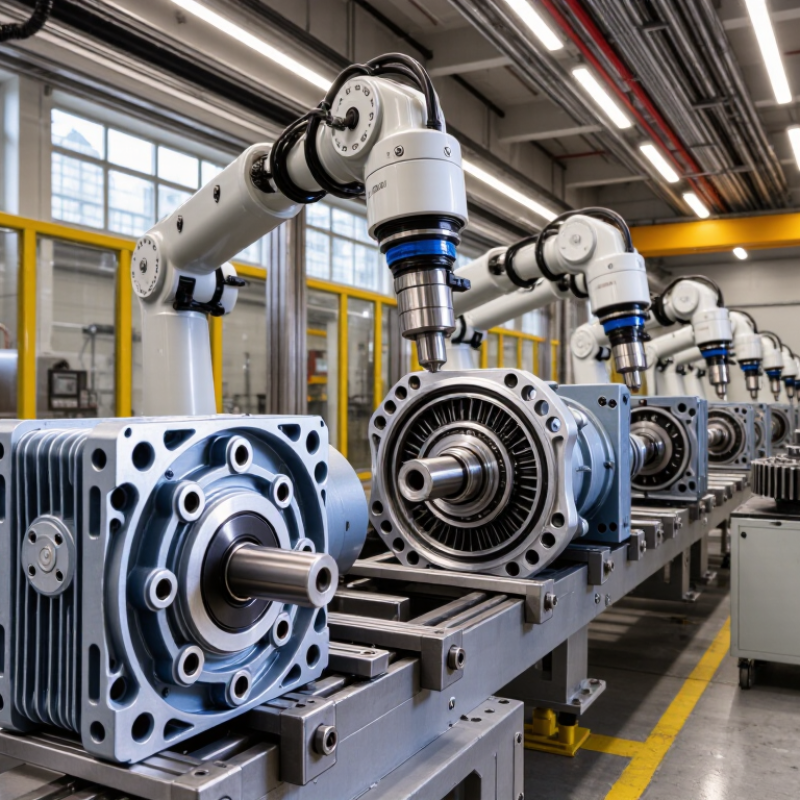
Who Are the Top Robotic Gear Manufacturers in China?

What Robotic Gears Are and Why They Matter

Robotic gears transmit motor power to a robot’s joints, shaping how smoothly and accurately each movement happens. A planetary gearbox can deliver high torque in a compact space, while a strain-wave design can offer low backlash for precise positioning. Cycloidal reducers are often chosen for demanding loads and shock resistance. Each design has trade-offs.

Backlash is the small amount of movement lost when a gear changes direction. In a pick-and-place arm, even slight play can shift a gripper away from a narrow target. That matters. Engineers also check rated torque, stiffness, speed, heat, lubrication, and expected service life—not just the advertised reduction ratio. A gearbox that performs well in a cool test may behave differently after hours of repeated motion. The right choice depends on the robot’s payload, duty cycle, joint size, and required accuracy. Specifications help, but they do not tell the whole story. A design can look ideal on paper and still prove noisy or difficult to maintain in a real assembly. It is an easy detail to underestimate.

How to Evaluate China’s Robotic Gear Manufacturers

China’s robotic-gear suppliers operate within a large automation market, but market size alone says little about component quality. The International Federation of Robotics’ World Robotics 2024 report records 276,288 industrial robot installations in China in 2023, about 51% of the global total. This is installation data, not gear-production data. Use it as market context, not proof of a supplier’s capabilities.

Evaluate each manufacturer against your robot’s actual load, speed, accuracy, and duty cycle. Request measured backlash, torsional stiffness, transmission efficiency, and noise data, with test conditions clearly stated. Check whether sample results match serial-production tolerances. Ask for material certificates, heat-treatment records, inspection plans, and life-test results under comparable loads. A polished catalog is not enough. Visit the workshop if possible; inspect machining, cleanliness, and how operators track rejected parts. No checklist is perfect, and supplier claims still need independent verification.

Tips: Send the same drawing and operating conditions to every candidate. Compare like with like. Ask for a traceable test report, then test a sample in your own assembly. Notice unexplained gaps in the data.

Leading Robotic Gear Manufacturers in China

China’s leading robotic gear manufacturers are best assessed by their engineering depth, not catalog size. Robotic joints need gears that handle repeated motion, changing loads, and tight positioning tolerances. A capable manufacturer should explain its tooth geometry, material choices, heat treatment, and inspection process in clear terms. Ask how backlash and transmission error are measured, and request test data for the intended operating range. The details matter.

Useful suppliers often support several stages, from prototype machining to stable production. Check whether they can discuss gear noise, temperature rise, lubrication, and wear under realistic duty cycles. These issues may seem small on a drawing, but they affect performance after thousands of movements. China has manufacturers serving different levels of precision and production volume, so comparisons should use the same specifications. A low quote alone says little.

Review sample parts, measurement reports, and communication quality before committing to a large order. Confirm that stated tolerances apply to finished components, not just selected samples. It is also sensible to ask how design changes are documented between production batches. Supplier claims can sound polished; evidence is more useful. Even careful screening cannot remove every risk, and that deserves an honest place in the selection process.

Robotic Gear Reducers: Typical Reduction Ratio Ranges

Indicative reduction-ratio ranges for common reducer types used in robotics. Actual ranges vary by design and product configuration.

Reduction ratio expresses how many input rotations correspond to one output rotation; higher ratios provide greater speed reduction.

How Chinese Manufacturers Compare by Gear Type and Capability

Chinese robotic gear manufacturers differ more by gear type and process control than by headline specifications. Harmonic drives suit compact joints that need high reduction ratios and low backlash. Cycloidal reducers often handle shock loads well, but their size and vibration behavior need careful review. Planetary gearboxes offer a practical balance of efficiency, stiffness, and cost for many robot axes. Spur gears may fit simpler mechanisms, though noise and backlash can limit precision.

Capability also depends on how consistently a factory controls tooth profiles, heat treatment, lubrication, and assembly. Ask for measured backlash, rated torque, efficiency, and life-test conditions—not just catalog values. Check whether the maker can supply matched motor-and-reducer assemblies or adapt shaft and mounting details. A clean sample is useful, but it does not prove batch consistency. I would want inspection records from more than one production lot.

Tips: Match the gear to the joint’s real load cycle. Request test data at your operating speed and temperature. Small details matter. If figures are unclear, ask how they were measured; a polished specification sheet can still leave gaps.

Who Are the Top Robotic Gear Manufacturers in China? - How Chinese Manufacturers Compare by Gear Type and Capability

How to read this comparison: This table compares gear technologies and the manufacturing evidence buyers should request from China-based suppliers. It does not rank or identify companies; capabilities vary by product model and should be verified with technical documentation and sample testing.

Gear type Typical robotic use Core manufacturing capability to assess Useful performance checks Evidence to request from a supplier
Harmonic (strain-wave) reducer Compact, high-ratio joints in lightweight and collaborative robot arms, including wrist and smaller-axis applications. Consistent manufacture of the flexspline, circular spline and wave generator; control of tooth geometry, assembly fit and lubrication. Lost motion, transmission error, torsional stiffness, efficiency, temperature rise and life under the intended load and duty cycle. Product-specific test reports, repeatability data, rated-life conditions, dimensional inspection records and documented lubrication requirements.
Cycloidal / RV reducer High-torque, high-stiffness joints, commonly used on heavier robot axes. Precision machining and finishing of cycloidal discs, pins, bearings and associated gears; controlled assembly and preload. Backlash or lost motion, torsional rigidity, output runout, efficiency, vibration, rated torque and service life. Load-test data, stiffness and backlash measurement methods, bearing specifications, materials and heat-treatment documentation, and service-life test conditions.
Planetary reducer Servo-driven robot axes, auxiliary axes and applications needing a compact, modular reduction stage. Accurate manufacture and assembly of sun, planet and ring gears; control of gear finishing, bearing support and lubrication. Backlash, transmission error, efficiency, noise, radial and axial runout, thermal behavior and rated life. Gear inspection results and the stated accuracy standard, backlash data by ratio, efficiency test conditions, and load and life ratings.
Bevel gear set Right-angle power transmission in selected robot wrist, joint or drive arrangements. Control of tooth geometry, mounting distance, alignment and contact pattern across the assembled gear pair. Backlash, contact pattern, transmission error, noise and vibration, efficiency, and durability under the specified load. Tooth-contact inspection, assembly tolerances, material and heat-treatment records, and test results for the complete gear set.

Comparison tip: Ask suppliers to report results for the exact reducer model and operating conditions being quoted. For cylindrical gears, ISO 1328-1 specifies an accuracy classification system; confirm that any cited standard is applicable to the gear type and that the supplier provides the measured results, not only a general compliance statement.

Industries and Robotics Applications Served by These Manufacturers

Chinese robotic gear manufacturers serve automotive, electronics, metalworking, logistics, and food-processing operations. Their products transmit torque through robot joints used for welding, machine tending, palletizing, and precise assembly.

The International Federation of Robotics’ World Robotics 2024 report records 276,288 industrial robot installations in China in 2023, about 51% of global installations. That scale creates demand for compact reducers that can handle repeated motion and tight positioning tolerances.

Applications differ sharply. Automotive lines need durable gearing for heavy payloads and long shifts; electronics factories favor compact, low-backlash units for fast, delicate placement. Warehouses use geared drive systems in mobile robots, while packaging plants need reliable motion around conveyors and case packers. Yet a catalog rating rarely captures heat, vibration, or maintenance conditions on a real production floor. Selection should consider load cycles, backlash, service life, and access to technical support—not torque alone.

Tips: Match the reducer to the robot’s actual duty cycle, not just its peak load. Ask for test conditions and lifecycle data. Small details matter. A missed thermal limit can become costly.

Article Source:

bottom of page