

What Are the Top Types of Automatic Arc Welding Machines?
Choosing the right Automatic Arc Welding Machine starts with the joint, material, and production environment—not the machine’s label alone. A system that lays long, continuous seams on thick steel plate may be poorly suited to thin stainless panels or short, varied welds. That distinction matters. Automatic welding can describe a process, a mechanized torch, or a robotic cell, and suppliers may use these terms differently.
This guide compares leading machine types by their arc process and practical strengths. Submerged arc welding machines suit many long, straight seams and high-deposition work. Automatic gas metal arc welding systems offer flexible wire feeding and are common in repeatable fabrication. Flux-cored arc systems can handle demanding production conditions, while mechanized TIG equipment offers careful control for thinner or more sensitive materials. Each brings trade-offs in setup, weld quality, operator skill, and maintenance. A fast cycle is not automatically a better result.
Look closely at the actual job. Consider material thickness, joint access, required travel speed, and how consistently parts can be positioned. A few millimeters of fit-up variation can change the outcome. The right choice may also depend on fixtures, power supply, wire or electrode handling, and inspection needs. No category wins every application. Even a well-specified machine can disappoint when the process settings or workholding are poorly matched. The sections ahead explain how the main types work, where they perform best, and what to check before comparing equipment.
How Automatic Arc Welding Machines Are Classified
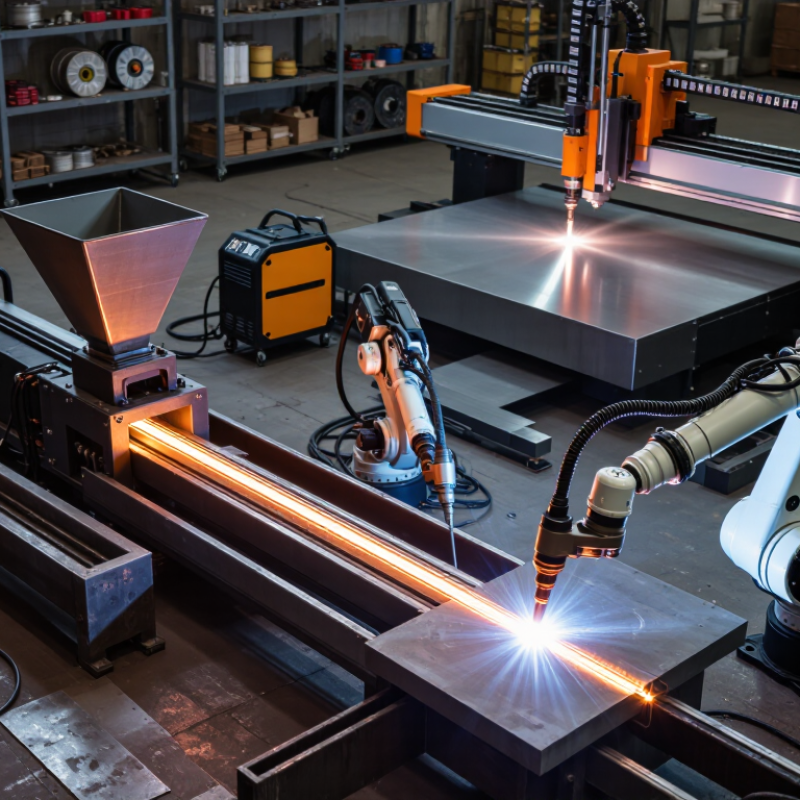
Automatic arc welding machines are classified by their level of automation, welding process, and method of movement. These categories can overlap; one cell may use a robotic arm and a specific arc process. The practical distinction is which tasks happen without an operator guiding each weld.
Small detail, big effect.
By automation level, equipment ranges from mechanized systems, where a person positions the torch, to fully automatic cells that control travel and weld settings.
Machines are also grouped by how they move the torch or workpiece: fixed stations, gantries, and robotic arms are typical examples.
By process, common types include submerged arc welding, gas metal arc welding, and gas tungsten arc welding. Submerged arc systems suit long, steady seams, while robotic gas metal arc systems can follow programmed paths around repeatable parts. Gas tungsten arc systems offer precise heat control, though setup and travel speed may demand more attention.
Not always obvious.
Power-source characteristics, such as current type and control mode, further distinguish equipment. In practice, catalogs make these labels look tidy. Shop conditions rarely do.
Joint access, part variation, and fixture accuracy can matter as much as the machine’s classification.
Automatic Submerged Arc Welding Machines
Automatic submerged arc welding (SAW) machines are designed for long, repeatable welds, especially on thick steel plate. A wire electrode feeds continuously beneath granular flux. The arc stays covered. This layer helps protect the molten weld metal and reduces visible arc glare. SAW is common on large structures, pressure-vessel shells, and pipe seams where steady travel is important.
A typical machine combines a power source, wire feeder, travel carriage, flux hopper, and control system. The carriage moves the welding head at a set speed as flux covers the weld area. Once the metal cools, the remaining slag must be removed before inspection. Unused flux can sometimes be collected and reused, if it remains clean and the welding procedure allows it. Small settings matter.
The operator must match the wire, flux, current, voltage, and travel speed to the joint. Too much heat can distort thinner sections, while poor fit-up may leave defects hidden beneath slag. I would not select a machine based on deposition rate alone. SAW is less flexible for vertical or overhead welding and awkward short seams. A narrow groove or misaligned joint can still challenge even a well-adjusted setup.
Automated Gas Metal Arc Welding Machines
Automated gas metal arc welding machines combine a welding power source, wire feeder, torch, shielding gas, and a programmed motion system. A robot or automated carriage guides the torch along the joint, keeping travel speed and torch angle more consistent than manual operation. That helps on repeatable parts. It is less straightforward when fit-up varies or access is tight.
The International Federation of Robotics reported 541,302 industrial robot installations worldwide in 2023 in its World Robotics 2024 report. That figure covers many industries, not welding alone, but it shows the scale of industrial automation.
In GMAW cells, sensors and seam tracking can help correct small part-position changes, while fixtures still matter: poor clamping can distort a joint before the arc starts. Small details count. Operators should verify wire feed, gas coverage, and settings on the actual material and joint, then inspect sample welds. Automation does not remove process judgment. A cell may run smoothly and still produce inconsistent welds if maintenance, programming, or part preparation slips. That part deserves honest attention.
Automated Gas Tungsten Arc Welding Machines
Automated GTAW systems pair a torch and nonconsumable tungsten electrode with shielding gas and programmed motion. They suit work that needs a clean bead and careful heat control, such as thin stainless steel enclosures or precision tubing. A controller can repeat travel speed, arc length, torch angle, and filler-wire timing across similar joints. Small details matter. The gas cup must protect the hot weld pool, while workpiece edges need consistent fit-up.
A typical cell may use a servo-driven torch, seam tracking, a fixture, and a programmable power source. Operators set current, pulse timing, gas flow, and travel path for the material and joint. A narrow tube seam, for example, may call for a steady torch path and modest filler addition. Sensors can detect some variation, but they cannot correct every poor cut or contaminated surface. That part still needs human attention.
GTAW automation offers repeatability, yet setup takes thought. Electrode wear, gas leaks, fixture drift, or a small change in joint gap can alter the bead. It is worth checking sample welds and recording parameter changes before production. Not glamorous, but useful. An automated machine may also be slower to reconfigure when jobs change often. The right choice depends on joint access, production volume, and quality requirements—not just travel speed.
Automatic Flux-Cored Arc Welding Machines
Automatic flux-cored arc welding machines feed tubular wire through a torch while controlling travel along a programmed path. The wire’s core contains fluxing ingredients that help shield the molten weld pool. This process suits production work where long, repeatable seams matter, such as joining steel frames or fabricating heavy equipment.
A useful system pairs a stable wire feeder with a travel carriage or robotic arm. Operators set wire-feed speed, voltage, torch angle, and travel speed to match the joint and material thickness. Small changes can affect penetration and bead shape. Watch the arc. A rough, inconsistent sound may point to poor settings, wire-feed trouble, or an uneven surface. Automatic motion improves consistency, but it cannot correct every fit-up problem.
Before production, test the settings on matching material and inspect the bead for undercut, porosity, or incomplete fusion. Keep the wire path clear, check contact tips regularly, and use suitable fume extraction. Flux-cored welding can create visible smoke and slag, so ventilation and protective equipment matter. Not every setup is obvious. A machine may run smoothly while producing a bead that needs adjustment; careful inspection remains part of the process.
What Are the Top Types of Automatic Arc Welding Machines? - Automatic Flux-Cored Arc Welding Machines
| Machine Type | FCAW Setup | How It Moves and Controls the Weld | Typical Applications | Key Considerations |
|---|---|---|---|---|
| Mechanized welding tractor or carriage | Usually a continuous wire-feed FCAW torch; may be configured for gas-shielded or self-shielded flux-cored wire. | A powered carriage travels along a seam or guide, maintaining a set travel speed while the operator sets and monitors welding parameters. | Long, accessible straight or gently curved welds on plate, frames, and structural assemblies. | Needs a suitable travel path and consistent joint fit-up. A carriage mechanizes travel but does not automatically correct poor alignment or changing joint geometry. |
| Fixed-head mechanized station | Typically uses gas-shielded FCAW where the workpiece and station can be kept in a controlled environment; self-shielded wire may be selected for suitable applications. | The torch remains mounted in a set position while a fixture holds or indexes the workpiece. Controls regulate wire feed, voltage, and related cycle settings. | Repeatable production of similar parts, welds, or assemblies in a dedicated work cell. | Fixtures and part presentation are important. Gas-shielded FCAW requires suitable shielding-gas delivery and protection from disruptive drafts. |
| Gantry or column-and-boom system | A mounted FCAW torch can use gas-shielded or self-shielded flux-cored wire, subject to the wire, equipment, and procedure requirements. | The torch is carried on a guided boom or gantry, allowing controlled movement along large or heavy workpieces. | Long seams on large plates, beams, tanks, and other components that are difficult to move through a compact station. | Requires adequate floor space, workpiece access, and accurate positioning. The system’s size and setup are best suited to planned production or large jobs. |
| Robotic FCAW cell | Commonly configured with gas-shielded FCAW for programmed production; wire and shielding choices depend on the welding procedure and work environment. | A programmable robot follows a taught or programmed path. Fixtures, sensors, and process controls can support repeatable positioning and monitoring. | Repetitive, multi-pass production welds on parts that can be positioned consistently within a cell. | Requires programming, safety guarding, suitable fixturing, and ongoing maintenance. Accurate part presentation is essential for consistent results. |
| Tandem-wire mechanized system | Uses two welding wires and coordinated power sources in a specialized FCAW arrangement; exact wire and shielding configurations depend on the procedure. | Two arcs operate in a coordinated setup to deposit metal along the weld path, with synchronized travel and process settings. | High-deposition production applications where the joint design, equipment, and qualified procedure are suited to tandem welding. | More complex to set up and control than single-wire FCAW. Requires compatible equipment, careful parameter coordination, and procedure qualification. |
Note: These machine types describe equipment configurations and can overlap with FCAW wire and shielding choices. Select equipment and consumables to match the joint, material, position, production needs, and qualified welding procedure.