

How to Choose a Robot Arm Coffee Machine
Choosing a Robot Arm Coffee Machine requires more than admiring its polished movements. The machine should deliver consistent extraction, safe operation, and a practical return on investment. A dramatic robotic arm means little if espresso tastes weak during the morning rush.
Coffee educator and industry expert James Hoffmann has said, “Coffee is a fruit.” This simple observation matters when evaluating automation. Fresh beans, controlled grinding, water temperature, and extraction time still shape every cup. The robot cannot rescue poor ingredients. It only repeats the process.
This guide examines the details that operators often overlook. We will compare brewing accuracy, cup capacity, cleaning requirements, software controls, maintenance access, and staff training. Watch the arm complete a full cycle. Does it move smoothly, or pause beside the portafilter? Listen for unusual grinding noise. Small delays can become expensive during busy service.
A good Robot Arm Coffee Machine should fit the location, not dominate it. Measure counter space, customer flow, power access, and ventilation before choosing a model. Review safety sensors and emergency-stop functions carefully. Ask suppliers for documented performance data, warranty terms, and local technical support.
There is no perfect machine.
A model that works beautifully in a hotel lobby may struggle in a crowded café. I would also avoid trusting impressive demonstrations alone. They show potential, not necessarily daily reliability. The strongest decision combines tasting tests, on-site observation, realistic cost calculations, and honest feedback from trained operators.
Understanding Robot Arm Coffee Machine Types and Core Functions
How to Choose a Robot Arm Coffee Machine
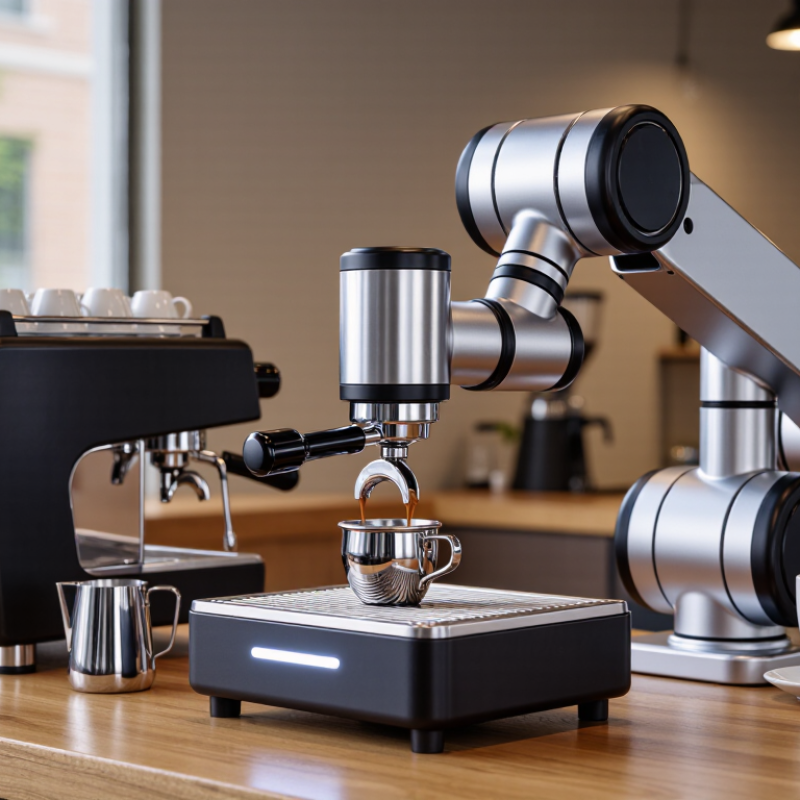
A robot arm coffee machine is not a single, fixed design. Compact models often handle cup placement, brewing, and simple drink delivery. Larger systems may manage grinding, extraction, milk texturing, lid fitting, and counter service. The arm’s reach matters. A short reach suits a small café counter, while a wider workspace supports several stations. Check the payload rating too. A full cup, portafilter, or milk pitcher can weigh more than expected.
Core functions should match the daily workflow. Look for accurate positioning, stable temperature control, adjustable brewing time, and repeatable dosing. Some systems use vision sensors to locate cups and detect obstacles. Others depend on fixed positions, which can reduce flexibility. Cleaning functions deserve close attention. Removable parts, rinse cycles, and clear access points reduce hygiene risks. In practice, complicated cleaning can weaken a good machine. That is easy to underestimate.
When choosing between types, observe the busiest ten minutes of service. Count cup sizes, drink variations, and staff movements. A machine that performs one recipe quickly may struggle with frequent changes. Check emergency stops, guarding, electrical protection, and operator training requirements. Noise levels also matter in a quiet café. Ask for maintenance records and realistic cycle times, not only demonstration results. No system is perfect. A slower, simpler model may prove more reliable than an impressive machine with fragile settings.
How to Choose a Robot Arm Coffee Machine - Understanding Robot Arm Coffee Machine Types and Core Functions
| Robot Arm Coffee Machine Type | Typical Arm Structure | Typical Payload | Typical Reach | Best Use Case | Main Advantages | Main Limitations |
|---|---|---|---|---|---|---|
| Six-Axis Articulated Arm | Six rotary joints with flexible positioning and orientation control | Approximately 3–10 kg, depending on the arm size | Approximately 0.5–1.3 m | Full beverage preparation involving portafilters, cups, steam wands, lids, and accessories | Highest flexibility; can imitate complex barista movements; suitable for multiple workstations | Higher cost, more complicated programming, and greater space and safety requirements |
| Collaborative Robot Arm | Usually six-axis or four-axis design with force and collision monitoring | Approximately 3–16 kg, depending on the selected model | Approximately 0.5–1.3 m | Cafés, offices, hotels, and retail areas where people work near the machine | Compact installation; can support supervised human–robot collaboration; generally easier to redeploy | Lower operating speed in some applications; a risk assessment and suitable safety configuration are still required |
| Four-Axis SCARA-Style Arm | Horizontal rotary joints with vertical movement for fast pick-and-place tasks | Approximately 1–10 kg | Approximately 0.4–1.0 m | Cup handling, lid placement, ingredient dispensing, and fixed-sequence beverage assembly | Fast horizontal movement; efficient for repetitive tasks; relatively compact footprint | Limited wrist orientation and less suitable for complex espresso-machine interactions |
| Cartesian or Gantry System | Linear X, Y, and Z axes, sometimes combined with a rotary end effector | Approximately 5–50 kg or more, depending on the frame design | Defined by the rail length; commonly 0.5–2.0 m in compact installations | High-volume beverage lines with fixed stations and predictable product flow | Accurate, repeatable, easy to map to fixed work zones, and capable of carrying heavier equipment | Large overhead structure; limited flexibility when workstation layouts change |
| Delta-Style Pick-and-Place System | Parallel-link arms mounted above the work area | Usually below 5 kg for compact pick-and-place applications | Typically 0.3–1.2 m, depending on the working envelope | Rapid cup, lid, straw, sachet, and garnish handling | Very high repetitive handling speed and good positioning consistency | Not well suited to force-intensive tasks, steaming, portafilter operation, or complex tool changes |
Core Functions to Compare Before Purchase
| Function or Specification | What It Controls | Practical Selection Guidance | Recommended Priority |
|---|---|---|---|
| Payload Capacity | The maximum mass the arm can safely handle at its specified reach | Include the cup, liquid, gripper, tool, and any acceleration forces; do not select only by the empty cup weight | High |
| Reach and Working Envelope | The distance and area the arm can access | Map the locations of the espresso machine, grinder, cup dispenser, sink, pickup counter, and cleaning zone before choosing the arm | High |
| Repeatability | How consistently the arm returns to the same programmed position | A repeatability of approximately ±0.02–0.10 mm is common in many industrial and collaborative arms; actual beverage accuracy also depends on fixtures and calibration | High |
| Operating Speed | The time required for pick, move, pour, press, and placement actions | Evaluate completed drinks per hour rather than only maximum joint speed; pouring and brewing time may be the true bottleneck | Medium to High |
| End-of-Arm Tooling | The gripper, cup holder, spoon, portafilter tool, or other attachment used by the arm | Choose food-contact materials that are suitable for sanitation, resistant to moisture, and easy to remove for cleaning | High |
| Force and Torque Sensing | Contact detection and controlled interaction with buttons, handles, portafilters, and containers | Useful when the robot must interact with equipment that has variable resistance or requires gentle handling | Medium to High |
| Recipe and Motion Programming | The storage and execution of drink recipes, movement sequences, and tool changes | Look for recipe editing, position teaching, permissions, error recovery, and remote monitoring capabilities | High |
| Safety System | Protection against collision, unexpected movement, access to hazardous areas, and equipment faults | Assess risk according to the installation; possible measures include guarding, safety scanners, emergency stops, speed limits, and validated collaborative modes | Essential |
| Hygiene and Cleanability | The ease of preventing contamination and cleaning beverage-contact components | Prefer smooth, sealed surfaces, removable tooling, minimal crevices, and a clear cleaning schedule for milk, syrup, coffee, and water residue | Essential |
| Integration Capability | Communication with brewers, grinders, dispensers, payment systems, sensors, and order platforms | Confirm available industrial communication interfaces, digital inputs and outputs, network access, and fault-reporting methods | High |
| Maintenance and Recovery | The ability to diagnose faults, resume interrupted orders, and replace tools or components | Prioritize clear alarms, manual recovery procedures, accessible service points, spare-part availability, and preventive maintenance records | High |
Note: Technical ranges are representative selection references rather than universal specifications. Actual performance depends on arm model, tooling, beverage equipment, workspace design, safety configuration, and programmed cycle time.
Related Posts
-
Ultimate Showdown of Best Robot Arm Coffee Machines for Global Buyers
-
How to Choose a Robot Barista for Your Business?
-
How to Choose a Coffee Vending Machine in 2026?
-
The Definitive Handbook to Coffee Robot Machines: Transforming Your Brewing Experience
-
Revolutionizing Coffee Experiences with the Latest Robot Coffee Machines for Global Buyers
-
2025 Trends in Coffee Tech: How the Best Coffee Machine Robots Will Revolutionize Brewing